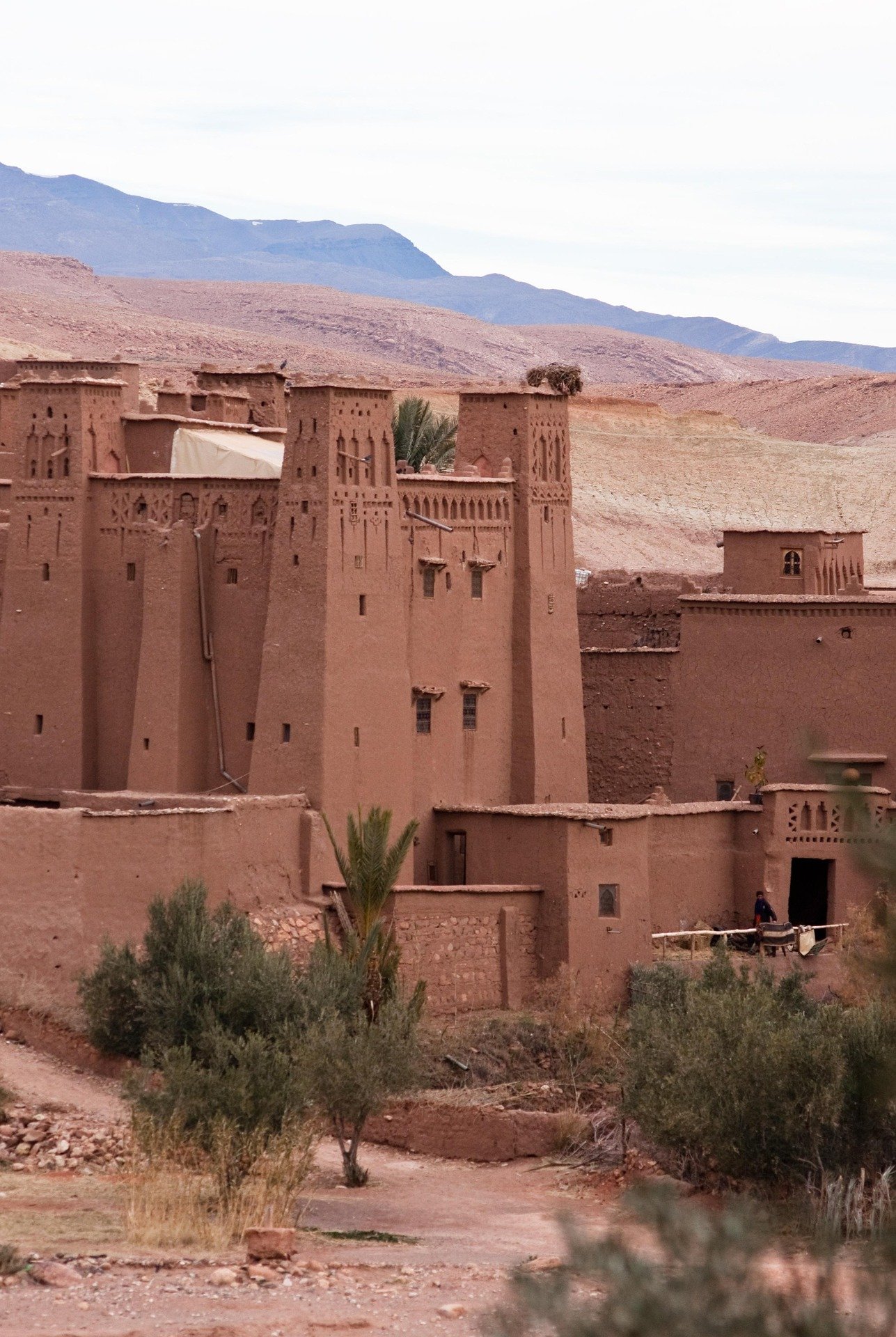
Moroccan kasbahs are among the most distinctive examples of traditional architecture in North Africa. Built from earth, clay, and other locally available materials, these fortified structures can be found throughout southern Morocco, particularly around the High Atlas Mountains, Ouarzazate, Skoura, the Dades Valley, and the routes leading toward the Sahara Desert.
With their tall walls, defensive towers, intricate decoration, narrow passages, and dramatic desert surroundings, Morocco’s kasbahs offer travelers an opportunity to discover a side of the country that goes far beyond its famous cities.
Some are beautifully preserved, others are partially ruined, and some have been transformed into museums, guesthouses, or cultural attractions.
If you’re traveling from Marrakech toward the Sahara, you’ll encounter several of the country’s most fascinating fortified settlements along the way.
What Is a Kasbah?
The word kasbah comes from the Arabic qasaba, generally referring to a fortified structure, citadel, or stronghold.
In Morocco, a kasbah traditionally referred to a fortified residence associated with a powerful family, local governor, military leader, or ruling authority.
Kasbahs could serve several purposes:
| Function | Purpose |
|---|---|
| Residence | Home for an influential family or local ruler |
| Defense | Protection against raids and conflict |
| Administration | Centre for managing a local area |
| Trade | Protection and control along important routes |
| Storage | Safekeeping of food and valuable goods |
| Community | Shelter and gathering place for local populations |
Their defensive design was particularly important in areas where communities were exposed to conflict or where important caravan routes passed through.
Kasbah vs Ksar: What’s the Difference?
One of the most common questions travelers have is whether a kasbah and a ksar are the same thing.
They aren’t exactly the same.
| Term | Meaning | Typical Structure | Example |
|---|---|---|---|
| Kasbah | Fortified residence or stronghold | Usually associated with one powerful family or authority | Kasbah Amridil |
| Ksar | Fortified settlement | Contains multiple homes and communal buildings | Aït Ben Haddou |
| Ksour | Plural of ksar | Several fortified settlements | Southern Moroccan villages |
This distinction is useful when exploring Morocco because some destinations are commonly called “kasbahs” by tourists even when they are technically ksour.
Aït Ben Haddou Is Technically a Ksar
The famous Aït Ben Haddou is technically a ksar, rather than a single kasbah.
The site consists of a fortified settlement containing numerous earthen buildings, communal areas, and other structures.
Nevertheless, you’ll frequently hear it described as a “kasbah” in travel guides and tourism conversations.
How Were Moroccan Kasbahs Built?
Traditional Moroccan kasbahs were commonly constructed using rammed earth, known locally as pisé, along with adobe and other earth-based materials.
The technique involves compacting layers of earth-based material within wooden forms to create thick walls.
The result is both practical and visually distinctive.
| Architectural Feature | Purpose |
|---|---|
| Thick earthen walls | Protection and insulation |
| Corner towers | Defense and visibility |
| Small openings | Security and temperature control |
| Central courtyard | Light, ventilation, and family life |
| Flat rooftops | Outdoor space and household activities |
| Decorative façades | Status and artistic expression |
| Heavy wooden doors | Security and craftsmanship |
One of the remarkable qualities of earthen architecture is its natural thermal performance. Thick walls help keep interiors relatively cooler during hot periods and retain warmth when temperatures drop.
However, earth construction is vulnerable to water and erosion, meaning historic kasbahs require regular maintenance and restoration.
The Architecture of Moroccan Kasbahs
The visual identity of Moroccan kasbahs comes from a combination of practical defensive architecture and decorative traditions.
You’ll often see:
- Geometric patterns
- Decorative towers
- Carved wooden doors
- Courtyards
- Adobe walls
- Traditional plasterwork
- Small windows
- Rooftop terraces
- Decorative crenellations
The architecture reflects centuries of interaction between different cultural traditions across Morocco and North Africa.
The Road of a Thousand Kasbahs
One of the most famous areas for exploring Moroccan kasbahs is the route commonly known as the Road of a Thousand Kasbahs.
Rather than being one perfectly defined modern road, the expression describes a network of routes through southern Morocco where travelers encounter numerous kasbahs, ksour, villages, palm oases, and fortified settlements.
The region around Ouarzazate, Skoura, the Dades Valley, and the southern Atlas is particularly rich in this architecture.
For travelers heading toward the Sahara, this makes the journey itself part of the experience.
4 Famous Kasbahs and Fortified Sites to Visit
1. Aït Ben Haddou
Aït Ben Haddou is arguably Morocco’s most famous fortified settlement.
Located near Ouarzazate, the dramatic earthen complex sits beside the former caravan routes linking the Sahara with Marrakech and other parts of Morocco.
Its reddish walls, towers, narrow lanes, and elevated position have made it one of Morocco’s most recognizable landmarks.
Aït Ben Haddou became a UNESCO World Heritage Site in 1987 and is frequently included on journeys between Marrakech and the Sahara.
Best for: History, architecture, photography, culture, and film enthusiasts.
2. Kasbah Taourirt
Located in Ouarzazate, Kasbah Taourirt is another important example of southern Moroccan architecture.
The kasbah was associated with the powerful Glaoui family and contains rooms decorated with traditional Moroccan craftsmanship.
Its location in Ouarzazate also makes it convenient to combine with other attractions in the area.
Best for: Architecture, history, and travelers exploring Ouarzazate.
3. Kasbah Telouet
Hidden in the High Atlas Mountains, Kasbah Telouet offers a very different experience.
Although parts of the building have deteriorated over time, sections of the interior reveal remarkable decoration, including intricate tilework, carved plaster, and painted ceilings.
Telouet is particularly interesting because it can be incorporated into an alternative route between Marrakech and Aït Ben Haddou.
Best for: Architecture, history, photography, and travelers looking for less conventional stops.
4. Kasbah Amridil
Located within the palm-filled Skoura Oasis, Kasbah Amridil is one of the best-known traditional kasbahs in Morocco.
Unlike Aït Ben Haddou, which is a fortified village, Amridil is a classic example of a kasbah associated with a family residence.
The surrounding oasis adds another dimension to the visit, with palm trees and agricultural landscapes contrasting beautifully with the reddish earthen walls.
Best for: Traditional architecture, oasis landscapes, photography, and cultural exploration.
Moroccan Kasbahs at a Glance
| Site | Region | Type | Best Known For |
|---|---|---|---|
| Aït Ben Haddou | Near Ouarzazate | Ksar | UNESCO heritage and film history |
| Taourirt | Ouarzazate | Kasbah | Glaoui history and architecture |
| Telouet | High Atlas | Kasbah | Decorative interiors |
| Amridil | Skoura Oasis | Kasbah | Traditional family fortress and oasis setting |
Moroccan Kasbahs and the Glaoui Family
The Glaoui family played an important role in the political and economic history of southern Morocco, particularly during the late 19th and early 20th centuries.
Several important fortified residences and palaces in southern Morocco are associated with the family.
Kasbahs such as Taourirt and Telouet provide travelers with a glimpse into the architecture and history connected with this period.
Exploring these buildings can help put the region’s impressive architecture into a broader historical context.
Kasbahs and the Sahara Caravan Routes
The location of many Moroccan kasbahs is not accidental.
Southern Morocco was historically connected to trans-Saharan trade networks. Caravans traveled between North Africa and regions farther south, carrying goods and connecting communities across vast distances.
Settlements along these routes needed protection, water, food storage, and places for travelers and traders to stop.
This helps explain why so many fortified structures developed around:
- Ouarzazate
- Skoura
- Dades
- Todra
- Draa Valley
- Zagora
- Other southern oases
Today, travelers following these same broad routes toward the Sahara can experience landscapes shaped by this history.
Kasbahs in Moroccan Films
Morocco’s dramatic architecture has attracted filmmakers from around the world.
Aït Ben Haddou and the surrounding Ouarzazate region have served as locations for major international productions.
Among the films and television productions associated with Aït Ben Haddou and the wider region are:
- Lawrence of Arabia
- Gladiator
- The Mummy
- Kingdom of Heaven
- Prince of Persia
- Game of Thrones
Ouarzazate has consequently developed a strong connection with the international film industry and is sometimes nicknamed “Hollywood of Morocco.”
For travelers interested in cinema, combining historic kasbahs with Ouarzazate’s film-related attractions can make an interesting addition to a Morocco itinerary.
Best Time to Visit Moroccan Kasbahs
The best time depends on the region and the season of your trip.
| Season | General Conditions | Recommendation |
|---|---|---|
| Spring | Mild temperatures and pleasant landscapes | ⭐ Excellent |
| Summer | Very hot in southern inland areas | Visit early or late |
| Autumn | Comfortable conditions | ⭐ Excellent |
| Winter | Mild days but cold mornings/evenings | Very Good |
For outdoor exploration, spring and autumn are generally comfortable choices.
If visiting during summer, try to explore exposed sites earlier in the day or later in the afternoon.
What to Bring When Visiting a Kasbah
Kasbah visits often involve uneven paths, stairs, exposed areas, and strong sunlight.
| Item | Why You Need It |
|---|---|
| Comfortable walking shoes | Uneven surfaces |
| Water | Important during warm weather |
| Sunscreen | Limited shade |
| Hat | Protection from the sun |
| Sunglasses | Bright conditions |
| Light layers | Temperatures can change |
| Camera | Excellent photography opportunities |
| Small amount of cash | Useful for local purchases or guides |
Respectful, comfortable clothing is also recommended when visiting rural communities and historic religious or cultural sites.
Photography Tips for Moroccan Kasbahs
Kasbahs are particularly photogenic because of their earth-colored walls and surrounding landscapes.
Early Morning
Morning light can create soft shadows and warm tones across the walls.
Late Afternoon
The lower angle of the sun can bring out the texture of the adobe architecture.
Sunset
Sunset can produce dramatic colors, particularly at elevated viewpoints.
Interior Photography
Inside historic kasbahs, look for:
- Doorways
- Decorative ceilings
- Zellige
- Plasterwork
- Courtyards
- Light entering through small windows
Always ask before photographing people, especially inside private homes or family-run properties.
How to Include Kasbahs in a Morocco Itinerary
Kasbahs are easiest to experience when incorporated into a broader southern Morocco journey.
From Marrakech
A typical route could be:
Marrakech → High Atlas → Aït Ben Haddou → Ouarzazate → Skoura → Dades Valley → Todra Gorge → Merzouga
This allows you to combine historic architecture with mountain scenery, valleys, oases, and the Sahara.
For a Shorter Trip
If you have limited time, consider:
Marrakech → Aït Ben Haddou → Ouarzazate → Marrakech
For a Longer Sahara Journey
Travelers with more time can continue through:
Marrakech → Aït Ben Haddou → Ouarzazate → Dades → Todra → Merzouga → Draa Valley → Marrakech
This provides a much deeper experience of southern Morocco.
Are Moroccan Kasbahs Worth Visiting?
Absolutely.
While Marrakech, Fes, Chefchaouen, and Essaouira are among Morocco’s most famous destinations, the country’s kasbahs reveal another side of Moroccan history and architecture.
They show how communities adapted to the climate, landscape, trade routes, and political realities of southern Morocco.
More importantly, visiting a kasbah is not simply about seeing an old building. It is about understanding the people, architecture, trade, traditions, and landscapes that shaped this part of Morocco.
Frequently Asked Questions
What is a kasbah in Morocco?
A kasbah is traditionally a fortified residence or stronghold, often associated with a powerful family, local authority, or ruler.
What is the difference between a kasbah and a ksar?
A kasbah generally refers to a fortified residence or stronghold, while a ksar is a fortified settlement containing multiple homes and communal buildings.
Is Aït Ben Haddou a kasbah?
Technically, Aït Ben Haddou is a ksar, or fortified village. It is commonly called a kasbah by tourists and travel businesses.
What is the most famous kasbah in Morocco?
Aït Ben Haddou is probably the most internationally famous fortified settlement in Morocco, although technically it is a ksar.
Where can I see the most kasbahs in Morocco?
The region between the High Atlas and the Sahara, particularly around Ouarzazate, Skoura, Dades, and the Draa Valley, is one of the best areas for exploring traditional kasbah architecture.
Can I visit Moroccan kasbahs from Marrakech?
Yes. Aït Ben Haddou can be visited from Marrakech, while other kasbahs are best experienced as part of a multi-day southern Morocco or Sahara itinerary.
Final Thoughts
Moroccan kasbahs are a powerful reminder of the country’s architectural and cultural history.
From the famous silhouette of Aït Ben Haddou to the decorated rooms of Telouet, the oasis setting of Amridil, and the historic walls of Taourirt, each site tells a different story.
For travelers heading from Marrakech toward the Sahara, these fortified structures make the road south much more than a simple transfer.
They are part of the destination.
And if you want to truly understand southern Morocco, take time to walk through its old kasbahs, explore its fortified villages, meet local communities, and appreciate the traditional architecture that has survived for generations.