
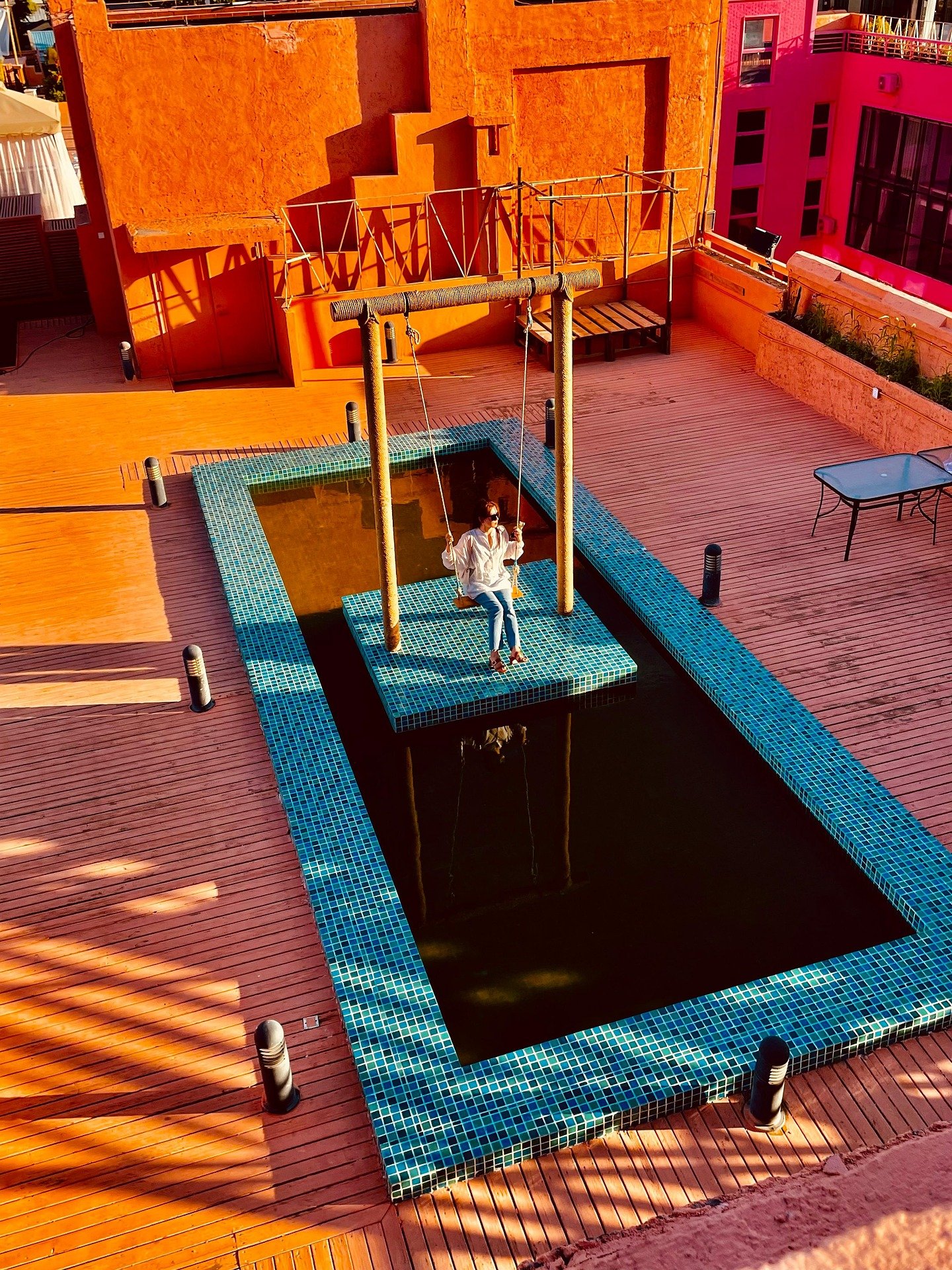
Inside a Moroccan Riad
A Moroccan riad is more than a beautiful place to stay. Behind its often-unassuming entrance is a world of courtyards, fountains, handmade tiles, carved wood, peaceful gardens, rooftop terraces, and centuries of Moroccan architectural tradition.
For many travelers, staying in a riad becomes one of the most memorable parts of visiting Morocco. Instead of entering a conventional hotel lobby, you may walk through a narrow medina street, open an understated wooden door, and suddenly find yourself surrounded by intricate zellige tiles, traditional arches, greenery, and the gentle sound of water.
The experience reflects something fundamental about traditional Moroccan architecture: the home often turns inward. Privacy, shade, natural light, water, craftsmanship, and family life come together around a central courtyard.
Today, historic Moroccan houses have been transformed into boutique guesthouses and small hotels, allowing visitors to experience this architectural heritage while enjoying modern comforts.
What Is a Moroccan Riad?
The word riad comes from the Arabic riyad, meaning “garden.” Traditionally, a riad refers to a house organized around an interior courtyard or garden.
Unlike many modern buildings that open toward the street, traditional riads are designed primarily around their interior spaces. Their exterior walls can appear relatively plain, while the courtyard and rooms inside may contain much more elaborate decoration.
This inward-facing design provided privacy while also creating a sheltered environment within the dense urban fabric of historic Moroccan medinas.
The central courtyard is the heart of the property. Rooms traditionally surround this space, while upper floors and galleries look inward toward the courtyard.
A traditional riad may include:
- A central courtyard or garden
- A fountain or small pool
- Zellige tilework
- Carved plaster
- Cedarwood ceilings and doors
- Decorative arches
- Traditional Moroccan furniture
- A rooftop terrace
- Rooms arranged around the central courtyard
It is worth noting that the word riad is now widely used in the tourism industry. Some properties marketed as riads are technically closer to traditional dar houses, which may have a courtyard without the formal garden associated with the classical riad.
The Courtyard: The Heart of a Moroccan Riad
The first thing many travelers notice when entering a Moroccan riad is the courtyard.
It can feel almost magical.
The contrast is often dramatic: a narrow, busy medina street gives way to a quiet interior filled with plants, patterned tiles, sunlight, and water.
The courtyard is not simply decorative. It traditionally performs several functions at once.
It brings natural light into the building, creates an interior social space, provides privacy, and helps moderate the atmosphere inside the house.
Water, plants, shade, and thick walls were all part of a broader architectural response to Morocco’s climate. (kamabia.com)
In some traditional designs, the courtyard is organized around a central fountain and garden arrangement. The geometry and symmetry can create a strong sense of balance and calm.
This is one reason a riad can feel surprisingly peaceful even when it is located in the middle of a lively medina.
Why Are Moroccan Riads Designed Inward?
Traditional Moroccan architecture places considerable importance on privacy.
Rather than creating large windows facing a busy street, the house directs attention toward its private interior.
From outside, a traditional riad can therefore look relatively simple. Inside, however, the architecture becomes much more expressive.
This creates a fascinating architectural contrast:
Outside:
Quiet walls, discreet entrances and limited openings.
Inside:
Courtyards, gardens, fountains, decorative tiles, carved plaster, woodwork and open galleries.
The entrance itself may also be arranged so that people outside cannot immediately see into the private interior of the home.
The result is an architectural experience based on discovery. You do not necessarily see the beauty of a riad from the street. You discover it after entering.
The Architecture and Craftsmanship Inside a Moroccan Riad
One of the greatest attractions of staying in a Moroccan riad is the opportunity to see traditional craftsmanship up close.
Many riads combine several different Moroccan artistic traditions within a relatively small space.
Zellige Tilework
Zellige is one of the most recognizable elements of Moroccan design.
These small geometric tiles can be arranged into highly intricate patterns covering floors, fountains, walls, columns and other architectural features.
The patterns are often colorful and mathematically precise, creating surfaces that immediately give a riad its distinctive Moroccan character.
Tadelakt Plaster
Another traditional material associated with Moroccan interiors is tadelakt, a smooth lime-based plaster traditionally polished to create a water-resistant surface.
It can be used on walls, bathrooms, columns and other architectural elements.
Its subtle texture contrasts beautifully with the geometric precision of zellige.
Carved Cedarwood
Woodwork is another important feature of traditional Moroccan interiors.
Cedarwood can appear in ceilings, doors, balconies and decorative elements. Intricate carving can transform an otherwise simple architectural surface into a work of art.
Carved Plaster
Look closely at the walls and arches of an old riad and you may find elaborate geometric or floral patterns carved into plaster.
Together, zellige, wood, plaster and other materials create the layered visual identity associated with Moroccan architecture.
What Does a Moroccan Riad Feel Like?
A riad is not only something to look at. It is an experience of atmosphere.
The courtyard may become the place where guests have breakfast in the morning, drink mint tea during the afternoon, or relax after exploring the medina.
The design naturally encourages travelers to slow down.
Instead of moving through a large hotel with long corridors and multiple restaurants, a small riad often feels more intimate. Common spaces are concentrated around the courtyard, and guests may interact more directly with the people running the property.
Many riads are small guesthouses rather than large hotels, which contributes to their personal atmosphere.
Moroccan Hospitality: More Than a Place to Sleep
Hospitality is an important part of the riad experience.
A stay may begin with traditional Moroccan mint tea, followed by a welcome into the courtyard and an introduction to the property.
Depending on the riad, guests may also experience:
- Traditional Moroccan breakfast
- Homemade meals
- Mint tea
- Moroccan pastries
- Rooftop dining
- Traditional hammam treatments
- Small courtyards and lounges
- Personalized recommendations
- Assistance arranging local experiences
Because many riads are relatively small, the experience can feel more personal than staying in a large international hotel.
The property itself becomes part of the cultural experience.
Staying in a Moroccan Riad vs. Staying in a Hotel
For travelers deciding between a riad and a conventional hotel, the difference is not simply about decoration.
| Moroccan Riad | Conventional Hotel |
|---|---|
| Usually smaller and more intimate | Often larger |
| Central courtyard | Lobby and corridors |
| Traditional architecture | Contemporary or standardized design |
| Often inside the medina | Can be outside or inside the medina |
| More personal atmosphere | More standardized service |
| Strong connection to local architecture | Often designed around international hotel standards |
| Rooftop terraces are common | Rooftop spaces vary |
| Stairs are often part of the building | Elevators are more common |
A riad can be particularly appealing if your priority is culture, atmosphere, architecture and location.
A conventional hotel may be preferable if you prioritize elevators, large facilities, extensive room-service options, gyms, conference facilities or standardized accessibility.
What Is It Like to Sleep in a Moroccan Riad?
Sleeping in a riad can feel very different from staying in a modern hotel.
Your room may face the courtyard rather than the street. Traditional doors, tiled bathrooms, handmade furniture and decorative ceilings can make the room feel more like part of a historic home than a standard hotel room.
At the same time, many restored riads now combine traditional design with modern amenities such as:
- Wi-Fi
- Air conditioning
- Private bathrooms
- Comfortable beds
- Hot water
- Modern lighting
- Swimming pools or plunge pools
- Rooftop seating
However, travelers should remember that historic buildings come with practical characteristics.
Stairs can be narrow, elevators are uncommon, and room layouts can vary considerably because many properties occupy historic buildings that were not originally designed as hotels.
Moroccan Riad Breakfast: A Cultural Experience
Breakfast in a riad can be one of the simplest and most enjoyable parts of the stay.
Rather than a standardized buffet, some riads serve breakfast in the courtyard or on the rooftop.
A traditional Moroccan breakfast may include:
- Moroccan bread
- Msemen
- Baghrir
- Fresh fruit
- Yogurt
- Olives
- Butter
- Honey
- Jam
- Mint tea
- Moroccan coffee
The exact breakfast varies from one property to another, but the emphasis is often on fresh ingredients and traditional Moroccan flavors.
For travelers who want to understand Moroccan food culture, breakfast provides a gentle introduction before heading into the medina for the day.
Rooftop Terraces: Another Side of the Riad
Many Moroccan riads have rooftop terraces that offer a completely different atmosphere from the courtyard below.
From the rooftop, travelers may enjoy views over the surrounding medina, nearby rooftops, minarets, palm trees or, in some locations and weather conditions, distant mountains.


Rooftops are often used for breakfast, evening tea, relaxation and dining.
In Marrakech, for example, a rooftop can provide an opportunity to experience the contrast between the intimate interior of the riad and the expansive city surrounding it.
The Best Cities for a Moroccan Riad Experience
Riads can be found in several Moroccan cities, but some destinations are particularly well known for their traditional medina architecture.
Marrakech
Marrakech is one of the most popular places to experience a Moroccan riad.
Many properties are located inside or around the historic medina, allowing travelers to combine accommodation with easy access to souks, historic monuments, restaurants and traditional neighborhoods.
The city is particularly famous for colorful interiors, rooftop terraces, courtyards and restored historic homes.
Fes
Fes offers a particularly atmospheric riad experience because its historic medina contains an extensive network of traditional streets and historic buildings.
Riads in Fes often showcase elaborate tilework, carved wood and traditional craftsmanship.
The city is an excellent choice for travelers interested in architecture, history and Moroccan artisan traditions.
Essaouira
Essaouira provides a different atmosphere.
Its traditional houses and guesthouses reflect the character of a historic Atlantic port city. Staying in a riad here can combine traditional Moroccan architecture with access to the ocean, medina and relaxed coastal atmosphere.
Rabat
Rabat also offers traditional architecture alongside a more modern urban environment.
For travelers who want to experience Moroccan culture without the intensity of some larger tourist centers, a stay in a traditional guesthouse can be an excellent option.
What Makes a Riad Different From a Dar?
Travelers will sometimes encounter another word when researching traditional Moroccan accommodation: dar.
A dar simply means “house” in Arabic.
Traditionally, both riads and dars are courtyard houses. The distinction is that a classical riad is associated with an interior garden, while a dar generally has a simpler courtyard. In modern tourism, however, the two terms are often used interchangeably.
For travelers, the most important thing is not necessarily the terminology.
Instead, look at the actual property.
Does it have a central courtyard?
Is it inside the medina?
Does it preserve traditional architecture?
Does it have a rooftop terrace?
How many rooms does it have?
Are bathrooms private?
Does it have air conditioning?
Are there many stairs?
These questions will tell you more about the experience than the word “riad” alone.
How to Choose the Right Moroccan Riad
Not every riad provides the same experience.
Before booking, consider the following:
1. Location
A riad deep inside a medina can provide an immersive cultural experience, but reaching it with luggage may require walking through narrow streets.
2. Accessibility
Historic riads often contain stairs and may not have elevators.
If accessibility is important to you, check the property carefully before booking.
3. Room Location
Courtyard-facing rooms can be beautiful, but sound may travel through the open central space.
If you are a light sleeper, ask about quieter rooms.
4. Air Conditioning and Heating
Morocco experiences significant seasonal temperature changes. Check what heating or cooling is available during your travel dates.
5. Breakfast
If breakfast is important to you, check what is included and whether traditional Moroccan options are available.
6. Rooftop
A rooftop terrace can add considerably to the experience, especially in Marrakech and Fes.
7. Authenticity
Look at photographs of the courtyard, ceilings, floors, doors and common areas rather than choosing a property based only on its room photos.
A Moroccan Riad Is an Experience, Not Just Accommodation
One of the biggest mistakes travelers can make is thinking of a riad simply as an alternative hotel.
The real attraction is the combination of architecture, atmosphere, hospitality and location.
You may wake up beneath a carved wooden ceiling, walk into a courtyard surrounded by zellige, have breakfast beside a fountain, spend the afternoon exploring the medina and return to the rooftop as the city begins to cool.
That rhythm creates a connection between your accommodation and the destination itself.
Instead of simply sleeping in Morocco, you are temporarily living inside a piece of Moroccan architectural heritage.
Staying in a Riad With Morocco Global Travel
For travelers exploring Morocco with Morocco Global Travel, staying in a traditional riad can be an excellent way to make accommodation part of the journey.
Rather than treating hotels as simply places to sleep between destinations, a well-selected riad can complement your experience of Marrakech, Fes, Essaouira and Morocco’s historic medinas.
Whether you are planning a romantic getaway, family holiday, cultural journey or private Morocco tour, accommodation can be selected according to your preferred level of comfort, location and travel style.
Tips for Your First Riad Stay
If it is your first time staying in a Moroccan riad, keep these tips in mind:
Expect a discreet entrance.
The exterior may look surprisingly simple compared with the interior.
Don’t judge the property from the street.
The magic of a riad is usually hidden inside.
Be prepared for stairs.
Many historic riads have several floors and no elevator.
Take time to enjoy the courtyard.
It is one of the defining features of the experience.
Try the traditional breakfast.
It is a simple way to discover Moroccan flavors.
Spend time on the rooftop.
Morning and evening are particularly enjoyable.
Respect the atmosphere.
Many riads are small and peaceful rather than large, busy hotels.
Ask the staff for local recommendations.
Their knowledge can help you discover restaurants, markets and experiences away from the busiest tourist areas.
Frequently Asked Questions About Moroccan Riads
What is a Moroccan riad?
A Moroccan riad is a traditional courtyard house, historically organized around an interior garden or courtyard. Many historic riads have been restored and converted into guesthouses and boutique accommodations.
Is staying in a riad worth it?
For travelers interested in Moroccan culture, architecture and local atmosphere, staying in a riad can be one of the most memorable accommodation experiences in Morocco.
Are Moroccan riads inside the medina?
Many traditional riads are located within historic medinas, particularly in cities such as Marrakech and Fes.
Do Moroccan riads have private bathrooms?
Many modern riads offer private bathrooms, but facilities vary by property. Always check the room description before booking.
Do riads have air conditioning?
Many renovated riads offer air conditioning, but this is not universal. It is worth confirming before booking, particularly for summer travel.
Are riads suitable for families?
Yes. Many riads welcome families, although travelers should check room configuration, stairs, pool safety and whether family rooms are available.
Are riads suitable for couples?
Absolutely. The intimate courtyards, rooftop terraces, traditional architecture and personalized atmosphere make riads particularly popular for romantic trips.
Are riads expensive?
Riad prices vary significantly depending on the city, season, location, room type and level of luxury. You can find simple guesthouses as well as highly luxurious restored properties.
Final Thoughts: Discovering Morocco Through a Riad
A Moroccan riad offers something that a conventional hotel cannot always provide: a direct connection with the architecture and traditions of the destination.
Behind a modest doorway, you may discover a peaceful courtyard, a fountain surrounded by greenery, handmade zellige, carved cedarwood and generations of Moroccan craftsmanship.
The experience is ultimately about more than architecture.
It is about slowing down, drinking mint tea, sharing breakfast, listening to the sounds of the medina and experiencing the warmth of Moroccan hospitality.
For travelers looking to understand Morocco beyond its famous monuments and landscapes, spending a few nights in a traditional riad can be one of the best ways to experience the country’s culture from the inside.
Media placement for the article
For the strongest visual presentation on your website, I would use 4–5 image sections rather than putting an image after every paragraph.
Hero image — immediately below the title


After “The Courtyard: The Heart of a Moroccan Riad”


After “The Architecture and Craftsmanship Inside a Moroccan Riad”


After “The Best Cities for a Moroccan Riad Experience”


After “Rooftop Terraces”


The visual concept works particularly well because the article moves naturally from outside → courtyard → craftsmanship → cities → rooftop, giving the reader a sense of actually entering and exploring a riad. The architectural features described above—courtyards, zellige, carved wood, plasterwork and inward-facing layouts—are characteristic elements of traditional Moroccan house design.