
The Almohad Dynasty: When Morocco Became the Heart of a Great Empire
Morocco’s history is filled with dynasties that changed the country forever.
The Almoravids built Marrakech and created a powerful empire stretching across Morocco and into Al-Andalus. But their rule would eventually face a formidable challenge from a new movement emerging in the High Atlas Mountains.
That movement was the Almohads.
The Almohads would overthrow the Almoravids, take control of Marrakech and build an empire that extended across much of North Africa and Muslim Spain.
Their influence can still be seen today in some of Morocco’s most recognizable monuments.
The Koutoubia Mosque in Marrakech, the Hassan Tower in Rabat, the historic settlement of Tinmel and numerous architectural traditions all carry connections to this extraordinary period.
But the Almohad story is about more than monuments.
It is a story of religious reform, mountain communities, political ambition, military expansion, intellectual life and one of the most powerful empires ever to emerge from medieval Morocco.
Who Were the Almohads?
The Almohads emerged in the early 12th century among the Masmuda Amazigh communities of the High Atlas.
The movement was founded by Ibn Tumart, a religious reformer who challenged the Almoravid rulers and called for a return to what he regarded as a purer form of Islamic belief and practice.
His followers became known as the Almohads, derived from al-Muwahhidun, generally understood as referring to the affirmation of the oneness of God.
At first, they were a religious movement based in the mountains.
Eventually, they became a political and military force capable of challenging the Almoravid Empire.
| Figure | Role | Importance |
|---|---|---|
| Ibn Tumart | Religious founder | Established the ideological foundations of the Almohad movement |
| Abd al-Mu’min | First major ruler | Turned the movement into a powerful empire |
| Abu Yaqub Yusuf | Almohad ruler | Expanded the empire and encouraged architecture and scholarship |
| Yaqub al-Mansur | Powerful ruler | Led the empire during one of its greatest periods |
| Almohad rulers | Imperial dynasty | Controlled extensive territories across North Africa and Al-Andalus |
The transformation from a mountain movement into a vast empire is one of the most remarkable developments in Moroccan history.
Ibn Tumart and the Beginning of the Almohad Movement
The story begins with Ibn Tumart.
Born among the Masmuda of the High Atlas, he traveled extensively and encountered different religious and intellectual traditions before returning to the Maghreb.
He criticized what he considered religious and political shortcomings among the Almoravids.
His teachings attracted followers, particularly among communities in the High Atlas.
The movement eventually established its center at Tinmel, a remote mountain settlement south of Marrakech.
Why Tinmel Matters
Tinmel is one of the most fascinating places associated with the Almohads.
Far from the busy streets of Marrakech, the mountain settlement became an important center for the movement.
It was here that the early Almohads developed their political and religious organization.
The dramatic landscape also tells part of the story.
The High Atlas provided the Almohads with a natural environment from which they could challenge the established power of the Almoravids.
| Location | Historical role |
|---|---|
| High Atlas Mountains | Homeland of the early Almohad movement |
| Tinmel | Early religious and political center |
| Marrakech | Former Almoravid capital later conquered by the Almohads |
| Rabat | Important Almohad city associated with major monuments |
| Seville | Major Almohad center in Al-Andalus |
Tinmel is therefore not simply another mountain village.
It represents the place from which a movement emerged that would eventually control an enormous territory.
Abd al-Mu’min: From Mountain Movement to Empire
Ibn Tumart died in 1130, but the movement he created continued under Abd al-Mu’min.
Abd al-Mu’min was a crucial figure in Almohad history.
While Ibn Tumart provided the ideological foundation, Abd al-Mu’min transformed the movement into a centralized political and military power.
The Almohads gradually expanded from their mountain stronghold.
They defeated Almoravid forces and moved toward the major cities of Morocco.
Their greatest prize was Marrakech.
In 1147, the Almohads captured the city.
The Almoravid era had come to an end.
A new chapter in Moroccan history had begun.
The Almohad Conquest of Marrakech
The capture of Marrakech was enormously significant.
The Almoravids had founded the city less than a century earlier.
Now their successors had taken control of the capital and were preparing to transform it into the center of an even larger empire.
The Almohads expanded and rebuilt parts of Marrakech, creating monumental architecture that would become symbols of their power.
The city that travelers know today therefore contains an important Almohad layer.
Its famous monuments are not all from the same period, but the Almohads played a major role in establishing Marrakech as a monumental imperial capital.
The Koutoubia: A Lasting Almohad Symbol
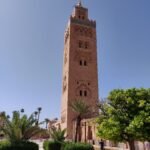
Perhaps the most recognizable Almohad monument in Morocco is the Koutoubia Mosque in Marrakech.
Its famous minaret dominates the city’s skyline.
Construction of the mosque began during the Almohad period, and the monument became one of the defining architectural symbols of Marrakech.
Its proportions and decorative style influenced later Moroccan and North African architecture.
The minaret is particularly important because it represents the visual language of Almohad power.
Simple, monumental and highly recognizable, it demonstrates how architecture could communicate the strength and sophistication of an empire.
The Koutoubia at a Glance
| Feature | Description |
|---|---|
| Location | Marrakech |
| Dynasty | Almohad |
| Function | Mosque and religious center |
| Most recognizable feature | Monumental minaret |
| Historical significance | One of Morocco’s best-known examples of Almohad architecture |
For visitors exploring Marrakech, the Koutoubia is therefore more than a beautiful landmark.
It is a reminder that the city was once the capital of a medieval empire stretching across North Africa and Al-Andalus.
The Almohad Empire Expands Across North Africa
After establishing control over Morocco, the Almohads expanded eastward.
They eventually brought large portions of the Maghreb under their authority.
Their empire extended through present-day Morocco, Algeria and Tunisia, while their influence also reached into parts of Libya.
This was an extraordinary achievement.
A movement that had begun in the mountains of Morocco had become one of the dominant powers of the western Islamic world.
| Region | Almohad connection |
|---|---|
| Morocco | Core territory and political center |
| Algeria | Incorporated into the expanding empire |
| Tunisia | Brought under Almohad control |
| Libya | Almohad influence extended into parts of the region |
| Al-Andalus | Major Almohad territories in Muslim Spain |
The scale of the empire demonstrates why the Almohad period is so important when studying medieval Morocco.
Morocco was no longer simply a regional kingdom.
It had become the center of a major trans-Mediterranean empire.
The Almohads in Al-Andalus
The Almohads inherited the Almoravids’ involvement in Iberian affairs.
As Christian kingdoms continued expanding southward, the Almohads became heavily involved in the defense of Muslim territories in Al-Andalus.
Cities such as Seville became important Almohad centers.
The cultural exchange between Morocco and Al-Andalus intensified.
Architecture, scholarship, philosophy, agriculture, craftsmanship and artistic traditions moved between the two sides of the Strait of Gibraltar.
One of the most famous surviving examples is the Giralda of Seville, whose original minaret was constructed during the Almohad period.
The connection between Marrakech and Seville is particularly fascinating.
Both cities preserve architectural reminders of a period when Morocco and Al-Andalus belonged to the same political world.
Yaqub al-Mansur and the Golden Age of the Almohads
Among the greatest Almohad rulers was Yaqub al-Mansur.
His reign is often considered one of the high points of Almohad power.
He was a capable military leader and an important patron of architecture.
During his rule, the empire reached considerable strength and major construction projects were undertaken.
One of the most famous events of his reign was the Battle of Alarcos in 1195, when Almohad forces defeated the army of Alfonso VIII of Castile.
The victory temporarily strengthened Almohad control in Al-Andalus.
Yaqub al-Mansur’s Legacy
| Area | Contribution |
|---|---|
| Military | Strengthened Almohad influence in Iberia |
| Architecture | Supported major monumental projects |
| Administration | Strengthened imperial authority |
| Culture | Encouraged scholarship and intellectual life |
| Marrakech | Reinforced the city’s role as an imperial capital |
His reign represents the Almohad Empire at close to the height of its influence.
The Hassan Tower: An Ambitious Almohad Monument
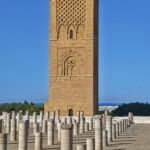
Travelers visiting Rabat encounter another extraordinary reminder of the Almohad period: the Hassan Tower.
The monument was commissioned during the reign of Yaqub al-Mansur in the late 12th century.
The original plan was extraordinarily ambitious.
The mosque was intended to become one of the largest in the Islamic world, but construction stopped after the ruler’s death.
The tower therefore stands today as an impressive fragment of an unfinished monumental project.
The monument offers travelers a fascinating insight into the ambitions of Almohad rulers.
They were not simply building places of worship.
They were creating monumental statements about political power, religious authority and imperial identity.
Almohad Architecture: Simple, Powerful and Monumental
The Almohad architectural style became one of the most influential traditions in Moroccan history.
Its influence can be recognized through monumental proportions, geometric decoration, carefully designed courtyards and distinctive minarets.
Several later Moroccan architectural traditions drew inspiration from Almohad forms.
| Architectural feature | Almohad significance |
|---|---|
| Monumental minarets | Powerful visual symbols of Islamic cities |
| Geometric decoration | Characteristic artistic language |
| Large prayer spaces | Reflected the importance of major urban mosques |
| Fortified walls | Combined practical and symbolic functions |
| Monumental gateways | Created impressive entrances to imperial cities |
This architectural legacy is one of the reasons Morocco feels visually connected across centuries.
The Almohads and Moroccan Cities
The Almohad period transformed more than Marrakech.
Several cities across Morocco and the wider Maghreb experienced significant development during this period.
Marrakech remained an important capital, while Rabat began to take on greater importance under Yaqub al-Mansur.
The Almohads also invested in infrastructure, fortifications and religious architecture.
| City | Almohad significance |
|---|---|
| Marrakech | Imperial capital and major center of power |
| Rabat | Major Almohad construction projects |
| Fez | Important Moroccan urban center |
| Meknes | Part of the wider imperial network |
| Tinmel | Early Almohad religious and political center |
This urban network helped strengthen the empire and connect different parts of Morocco.
Scholarship, Philosophy and Intellectual Life
The Almohad period was not only an age of military expansion.
It was also a remarkable period of intellectual activity.
The empire existed within a wider Islamic world where scholars, philosophers, physicians and poets moved between major cities.
One of the most famous intellectual figures associated with the Almohad period was Ibn Rushd, known in Europe as Averroes.
Born in Córdoba, Ibn Rushd became an influential philosopher, physician and jurist whose work would later have an enormous impact on European and Islamic intellectual history.
Another major thinker, Ibn Tufayl, also lived during the Almohad period.
This intellectual environment demonstrates that the medieval Moroccan world was deeply connected with wider networks of scholarship.
Ideas traveled alongside merchants, diplomats and armies.
Why the Almohads Were So Powerful
The Almohad Empire succeeded because several factors came together.
Their movement had a strong ideological foundation, but military organization and political leadership were equally important.
The geography of Morocco also played a role.
The High Atlas provided a natural base for the movement, while Marrakech offered an established imperial capital once the Almoravids had been defeated.
The Foundations of Almohad Power
| Factor | How it helped the Almohads |
|---|---|
| Religious movement | Created a strong ideological identity |
| Amazigh support | Provided a powerful social and military base |
| High Atlas | Offered a defensible area for the early movement |
| Marrakech | Became a major imperial capital |
| Military organization | Enabled rapid territorial expansion |
| Strategic geography | Connected Morocco with North Africa and Al-Andalus |
The combination allowed the Almohads to move from a relatively localized movement to an empire spanning two sides of the Mediterranean.
The Decline of the Almohad Empire
No medieval empire lasted forever.
After the height of Almohad power, internal divisions began to weaken the state.
The political situation in Al-Andalus also changed dramatically.
Christian kingdoms continued to expand, while Almohad authority became increasingly difficult to maintain across such a large territory.
The decisive turning point came with the Battle of Las Navas de Tolosa in 1212.
The Almohad army suffered a major defeat against a coalition of Christian kingdoms.
Although the empire did not collapse immediately, its authority in Iberia was severely weakened.
Over the following decades, the Almohad state gradually fragmented.
By the mid-13th century, new regional powers were emerging across North Africa.
In Morocco, the Marinids would eventually become the dominant force.
From the Almohads to the Marinids
The transition between dynasties once again demonstrates how Moroccan history developed through layers.
The Almoravids established Marrakech.
The Almohads captured it and transformed it.
The Marinids later shifted their political focus toward Fez.
Each dynasty inherited cities, roads, institutions and traditions from the previous one while adding its own identity.
| Dynasty | Major contribution |
|---|---|
| Idrisids | Early Islamic political foundations and development of Fez |
| Almoravids | Foundation of Marrakech and expansion toward Al-Andalus |
| Almohads | Imperial expansion and monumental architecture |
| Marinids | Fez’s development as a major intellectual and religious center |
| Saadians | Architectural revival and expansion of Marrakech |
| Alaouites | Establishment of the dynasty that rules Morocco today |
Understanding this sequence makes traveling through Morocco much more meaningful.
A city is rarely connected to only one dynasty.
Instead, its identity is the result of centuries of transformation.
The Almohad Legacy You Can See Today
The remarkable thing about the Almohads is that their legacy has survived in places travelers can still visit.
In Marrakech, the Koutoubia dominates the skyline.
In Rabat, the Hassan Tower recalls the ambitions of Yaqub al-Mansur.
In the High Atlas, Tinmel connects visitors with the origins of the movement.
Across the Strait of Gibraltar, Seville preserves another major part of the Almohad story.
These places demonstrate how far the influence of a movement that began in the Moroccan mountains eventually reached.
Best Places to Discover Almohad History
If you want to explore this period during a trip to Morocco, these destinations are particularly worthwhile.
| Destination | Historical highlight | Recommended experience |
|---|---|---|
| Marrakech | Almohad imperial capital | Koutoubia, medina and historic city walls |
| Rabat | Major Almohad construction | Hassan Tower and historic monuments |
| Tinmel | Birthplace of Almohad power | Historic mosque and High Atlas landscapes |
| Fez | Major city during successive dynasties | Medina, religious architecture and traditional crafts |
| High Atlas | Homeland of the early movement | Mountain landscapes and traditional villages |
A historical journey through these places can be combined with the Sahara, Aït Ben Haddou and Morocco’s imperial cities for a much broader understanding of the country’s past.
A Journey Through Morocco’s Medieval History
For travelers fascinated by medieval Morocco, one of the best ways to experience the country’s history is to follow the rise and fall of its great dynasties.
You could begin in Fez, where the Idrisids established one of Morocco’s earliest great capitals.
Continue to Volubilis, where Roman and early Islamic history meet.
Travel to Marrakech, where the Almoravids established their capital and the Almohads later created a monumental imperial center.
Continue through the High Atlas, where the Almohad movement first developed.
Then travel south toward the Sahara, where the history of caravan trade connects Morocco with the wider African continent.
This turns a standard vacation into a journey through more than a thousand years of Moroccan history.
Almohad Dynasty Timeline
| Date | Event |
|---|---|
| Early 12th century | Ibn Tumart begins the Almohad religious movement |
| 1130 | Ibn Tumart dies |
| 12th century | Abd al-Mu’min consolidates Almohad power |
| 1147 | Almohads capture Marrakech |
| Late 12th century | Almohad power expands across North Africa and Al-Andalus |
| 1195 | Almohad victory at Alarcos |
| Late 12th century | Major construction projects including Hassan Tower begin |
| 1212 | Almohads suffer a major defeat at Las Navas de Tolosa |
| 13th century | Almohad political authority gradually declines |
| Mid-13th century | Marinid power rises in Morocco |
Frequently Asked Questions About the Almohad Dynasty
Who founded the Almohad movement?
The Almohad movement was founded by Ibn Tumart, a religious reformer from the High Atlas region of Morocco.
Who was the first Almohad ruler?
After Ibn Tumart’s death, Abd al-Mu’min became the leading figure of the movement and transformed it into a powerful empire.
When did the Almohads capture Marrakech?
The Almohads captured Marrakech in 1147, ending Almoravid control of the city.
What did the Almohads build in Morocco?
The Almohads were responsible for major architectural projects, including important works in Marrakech and Rabat. The Koutoubia and Hassan Tower are among the most famous monuments associated with their period.
What was the Almohad capital?
Marrakech became one of the principal capitals and political centers of the Almohad Empire.
Did the Almohads rule Spain?
The Almohads controlled substantial territories in Al-Andalus, including major cities such as Seville, during the height of their empire.
What caused the decline of the Almohads?
A combination of internal political difficulties, the loss of territory in Al-Andalus and military defeats weakened the empire. The Battle of Las Navas de Tolosa in 1212 was a major turning point.
Which dynasty came after the Almohads?
The Marinids eventually became the dominant dynasty in Morocco after the decline of Almohad authority.
Discover the Morocco of the Almohads
The Almohad Dynasty left behind one of the most fascinating chapters in Moroccan history.
It began with a religious movement in the High Atlas.
It grew into a powerful empire.
It captured Marrakech.
It extended across North Africa and Al-Andalus.
It produced remarkable architecture.
And eventually, like every great medieval empire, it declined.
Yet its legacy remains.
When you stand beneath the Koutoubia in Marrakech, admire the Hassan Tower in Rabat or look toward the mountains surrounding Tinmel, you are seeing fragments of a history that once connected Morocco with an enormous part of the medieval Islamic world.
At Morocco Global Travel, we believe Morocco is best experienced through the stories behind its landscapes and monuments.
A journey through Morocco can be designed around the country’s great dynasties, combining Fez, Volubilis, Marrakech, the High Atlas, Aït Ben Haddou and the Sahara Desert into one unforgettable historical adventure.
You do not have to choose between history and adventure.
In Morocco, they are often part of the same journey.
Travel through Morocco’s landscapes. Walk through its history. Discover the empire that transformed medieval Morocco.