Roman Morocco History of Volubilis
When travelers think about the Roman Empire, they often picture Italy, France, Spain or Greece.
Morocco rarely comes to mind.
Yet, more than 2,000 years ago, the northwestern corner of Africa was connected to the Roman world. Roman administration, trade, architecture and urban life reached parts of what is now Morocco, leaving behind one of the country’s most remarkable archaeological sites: Volubilis.
Located near the modern town of Moulay Idriss Zerhoun, Volubilis is Morocco’s best-known Roman archaeological site and one of the most important places to understand the country’s ancient history.
But calling Volubilis simply “Roman ruins” does not tell the complete story.
The city existed before Roman rule. It developed within the ancient Kingdom of Mauretania, became part of the Roman province of Mauretania Tingitana, and continued to be inhabited after Rome’s direct control declined.
Its story connects indigenous North African populations, Amazigh history, ancient kingdoms, Roman expansion, Christianity, early Islam and the beginnings of the Moroccan state.
UNESCO recognizes Volubilis as an exceptionally well-preserved archaeological site representing several layers of history, including Mauritanian, Roman, Christian and Islamic periods.
Today, walking through Volubilis means walking through more than one civilization.
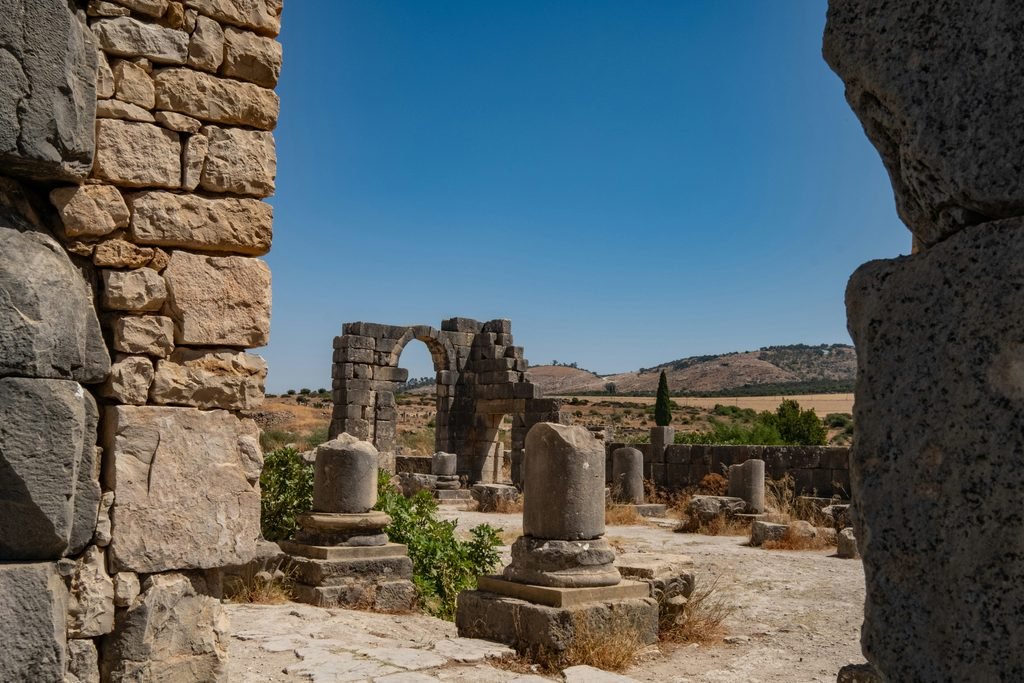
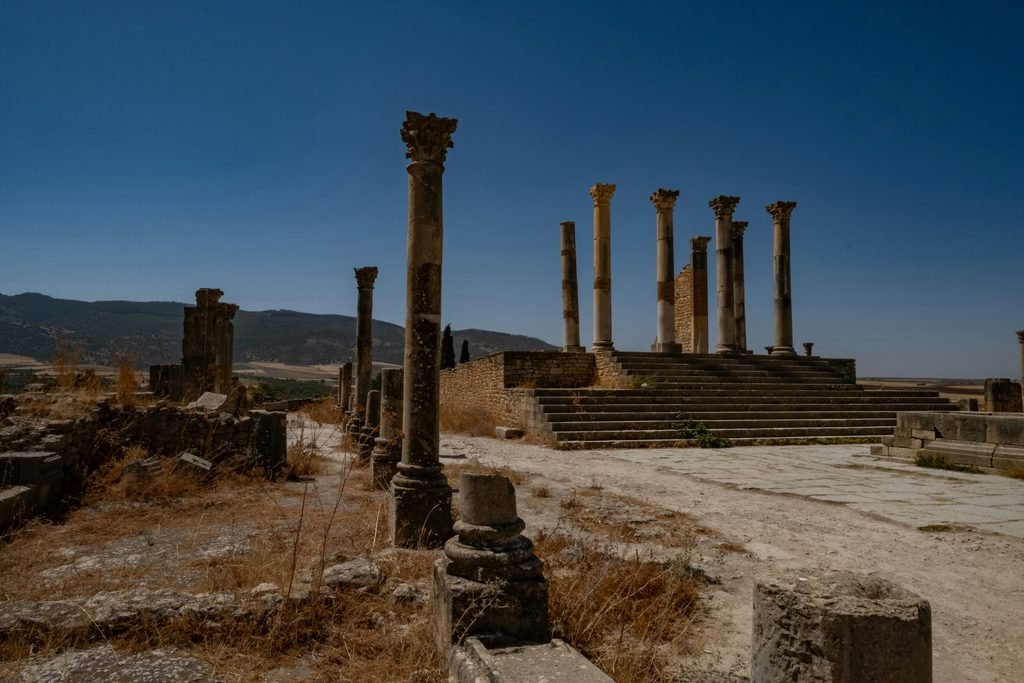
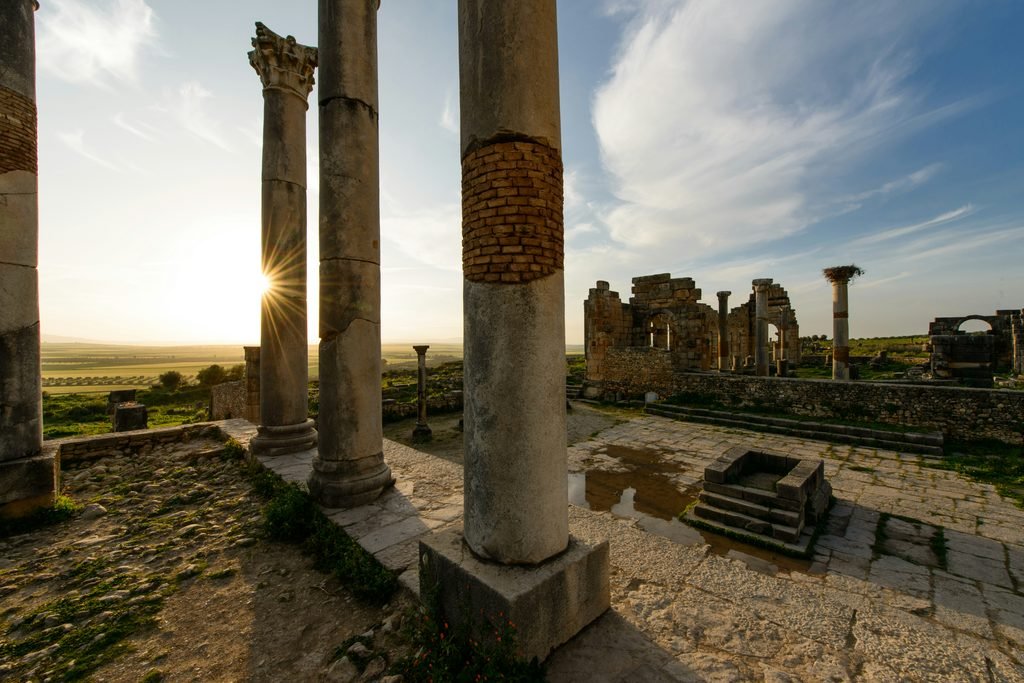
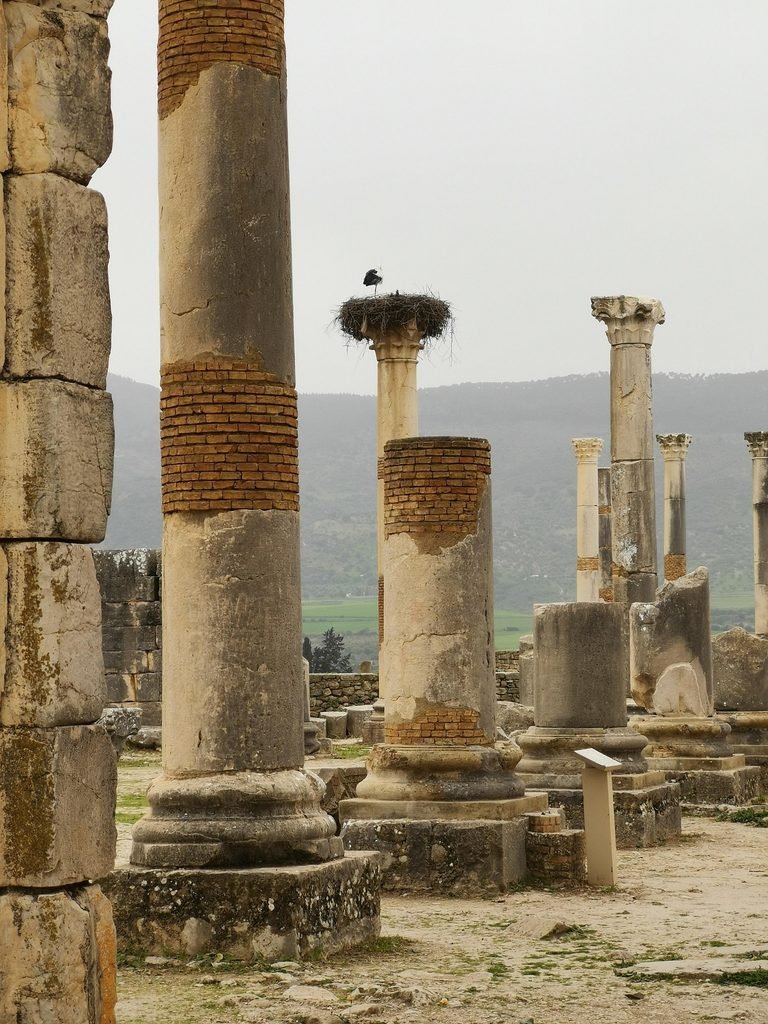
It is one of the rare places in Morocco where you can stand among monumental Roman columns, admire intricate mosaics and then look out across the same Moroccan countryside that connected the ancient city to the wider world.
Volubilis at a Glance
| Question | Answer |
|---|---|
| What is Volubilis? | An ancient archaeological city in northern Morocco |
| Where is Volubilis? | Near Moulay Idriss Zerhoun, between Meknes and Fez |
| Was Volubilis Roman? | Yes, it became an important city under Roman rule, but it existed before Rome |
| What Roman province was it part of? | Mauretania Tingitana |
| When was Volubilis important? | From the pre-Roman period through the Roman era and beyond |
| Why is it famous? | Roman ruins, mosaics, public buildings and multiple layers of history |
| Is Volubilis a UNESCO World Heritage Site? | Yes |
| Can you visit Volubilis from Marrakech? | Yes, usually as part of a longer route or private historical tour |
| Is Volubilis close to Fez? | Yes, making it a popular historical excursion from Fez and Meknes |
Where Is Volubilis Located?
Volubilis is located in northern Morocco, near Moulay Idriss Zerhoun, approximately between the major cities of Meknes and Fez.
Its position was strategically important.
The city developed within a fertile agricultural landscape, giving it access to resources that supported a significant population.
It was also connected to routes linking different parts of ancient Mauretania.
Volubilis Location and Travel Context
| Destination | Relationship to Volubilis |
|---|---|
| Moulay Idriss Zerhoun | Located very close to the archaeological site |
| Meknes | One of the nearest major cities |
| Fez | Popular starting point for a historical day trip |
| Rabat | Accessible as part of a longer northern Morocco itinerary |
| Chefchaouen | Can be included within a northern Morocco route |
| Marrakech | Usually visited during a longer multi-day Morocco itinerary |
Its location makes Volubilis particularly attractive for travelers who want to combine different periods of Moroccan history.
You can explore Roman ruins, visit the nearby sacred city of Moulay Idriss and continue toward the imperial city of Meknes—all within the same region.
What Was Volubilis Before the Romans?
One of the biggest misconceptions about Volubilis is that the Romans founded the city.
They did not.
Volubilis was already an important settlement before it became part of the Roman Empire.
The site developed in the ancient region associated with the Kingdom of Mauretania, a North African kingdom that covered areas of present-day Morocco and western Algeria.
Indigenous populations lived in and around the region, while the settlement became connected with wider Mediterranean trade networks.
By the time Rome established direct control, Volubilis was therefore not an empty location waiting to become a Roman city.
It already had history.
Volubilis Before Roman Rule
| Historical Layer | Development |
|---|---|
| Indigenous settlement | Local North African populations inhabited the region |
| Mauritanian period | Volubilis developed within the ancient Kingdom of Mauretania |
| Mediterranean contact | Trade connected the region with wider ancient networks |
| Pre-Roman urban growth | The settlement developed before formal Roman administration |
| Roman incorporation | Rome later transformed and expanded the city |
This is important because it places Roman Morocco within the larger history of the country.
Rome was one chapter—not the beginning.
The Kingdom of Mauretania and Volubilis
Before direct Roman rule, Volubilis belonged to the wider political world of ancient Mauretania.
Mauretania was an indigenous North African kingdom.
Despite the similarity in name, it should not be confused with the modern country of Mauritania.
The ancient kingdom covered territories that included parts of northern Morocco and western Algeria.
Its rulers interacted with powerful Mediterranean states, including Rome.
One of the best-known rulers was Juba II, whose reign illustrates how deeply connected North Africa had become to the wider ancient world.
Ancient Mauretania at a Glance
| Feature | Description |
|---|---|
| Location | Northwestern Africa |
| Modern geography | Included parts of present-day Morocco and western Algeria |
| Political structure | Indigenous North African kingdom |
| Major connections | Mediterranean trade and diplomacy |
| Famous ruler | Juba II |
| Later development | Divided and incorporated into Roman provincial administration |
Volubilis developed within this changing political environment.
When Did Rome Take Control of Morocco?
Roman control over parts of northern Morocco developed after the Kingdom of Mauretania was incorporated into the Roman system.
Following the death of King Ptolemy of Mauretania in the first century CE, Rome annexed the kingdom.
The territory was later divided into provinces, including Mauretania Tingitana, covering northern areas of present-day Morocco.
Volubilis became one of the important cities within this province.
The Roman Expansion into Mauretania
| Period | Development |
|---|---|
| Before 1st century CE | Mauretania existed as an indigenous kingdom |
| Reign of Juba II | Strong political connections developed with Rome |
| Early 1st century CE | Roman influence continued to increase |
| 40 CE | Rome annexed Mauretania after the death of King Ptolemy |
| Roman period | Mauretania was reorganized into provinces |
| Later Roman era | Volubilis became an important urban center in Mauretania Tingitana |
Roman control did not extend equally across all of modern Morocco.
The empire focused most heavily on northern and strategically important regions.
Large areas beyond the effective frontier remained outside direct Roman administration.
What Was Mauretania Tingitana?
Mauretania Tingitana was the Roman province covering parts of northern Morocco.
The name came from Tingis, the ancient city of Tangier.
The province connected North Africa with the wider Roman Empire.
Roman administration introduced new political and urban structures, while local populations remained an essential part of society.
Mauretania Tingitana
| Feature | Information |
|---|---|
| Roman province | Yes |
| Main region | Northern Morocco |
| Name origin | Tingis, ancient Tangier |
| Important cities | Tingis, Volubilis and others |
| Economic role | Agriculture, trade and production |
| Strategic importance | Connected Africa with Mediterranean and Iberian territories |
The province represented Rome’s westernmost African frontier.
This made it both distant from Rome and strategically important.
Life in Roman Volubilis
At its height, Volubilis was a thriving urban center.
Its residents lived in houses of varying sizes and wealth. The city contained public buildings, temples, baths and commercial areas.
Roman urban planning shaped many aspects of the city, particularly its streets and monumental structures.
However, life in Volubilis was not identical to life in Rome.
The city existed within North Africa and developed through the interaction of Roman and local traditions.
Daily Life in Volubilis
| Aspect | What It Involved |
|---|---|
| Housing | Residences ranging from modest structures to wealthy homes |
| Religion | Roman religious traditions alongside local influences |
| Trade | Exchange of agricultural and manufactured goods |
| Agriculture | The fertile surrounding region supported economic activity |
| Public life | Forums, streets, baths and civic buildings |
| Social structure | Local elites, administrators, merchants and workers |
| Culture | A mixture of Roman and North African influences |
The remains visible today provide clues about how people lived nearly two millennia ago.
The Streets of Volubilis
Walking through Volubilis today, one of the first things visitors notice is the scale of its streets.
The city’s main roads connected important buildings and neighborhoods.
Stone paving, columns and monumental structures demonstrate the importance of urban planning during the Roman period.
The famous Decumanus Maximus formed one of the principal routes through the city.
Along it stood public buildings, wealthy residences and important monuments.
Important Areas of Roman Volubilis
| Area | Historical Function |
|---|---|
| Decumanus Maximus | Main east-west urban street |
| Forum | Center of public and civic activity |
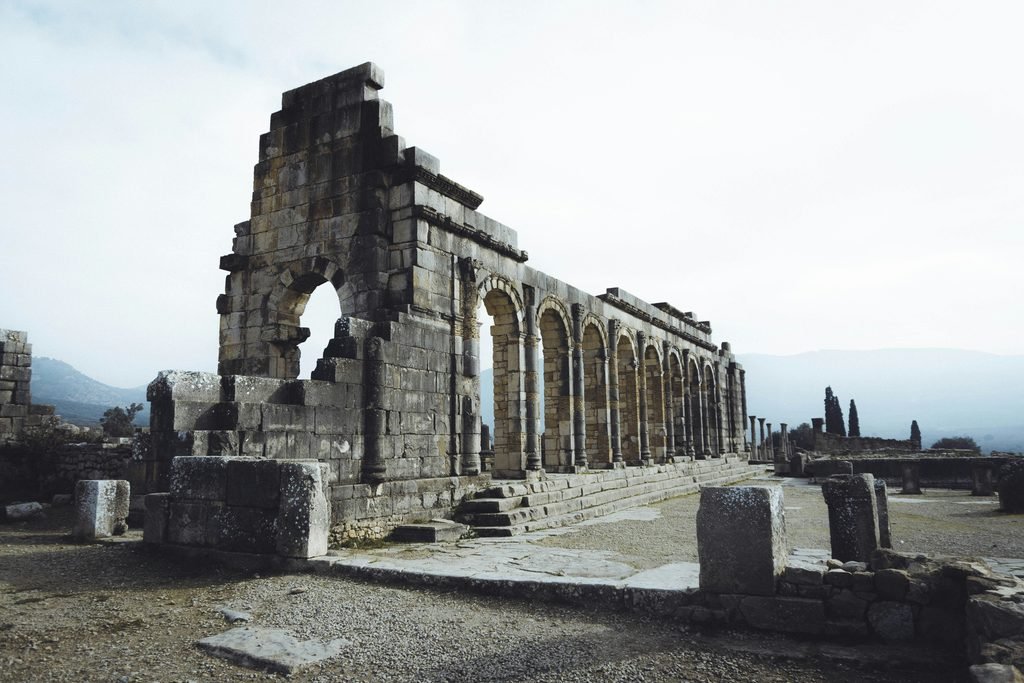
| Basilica | Administrative and legal functions |
| Capitol | Major religious and ceremonial area |
| Triumphal Arch | Monument celebrating Roman imperial power |
| Houses | Residential areas containing famous mosaics |
| Baths | Important spaces for hygiene and social life |
These remains make Volubilis one of the most visually impressive historical sites in Morocco.
The Triumphal Arch of Caracalla
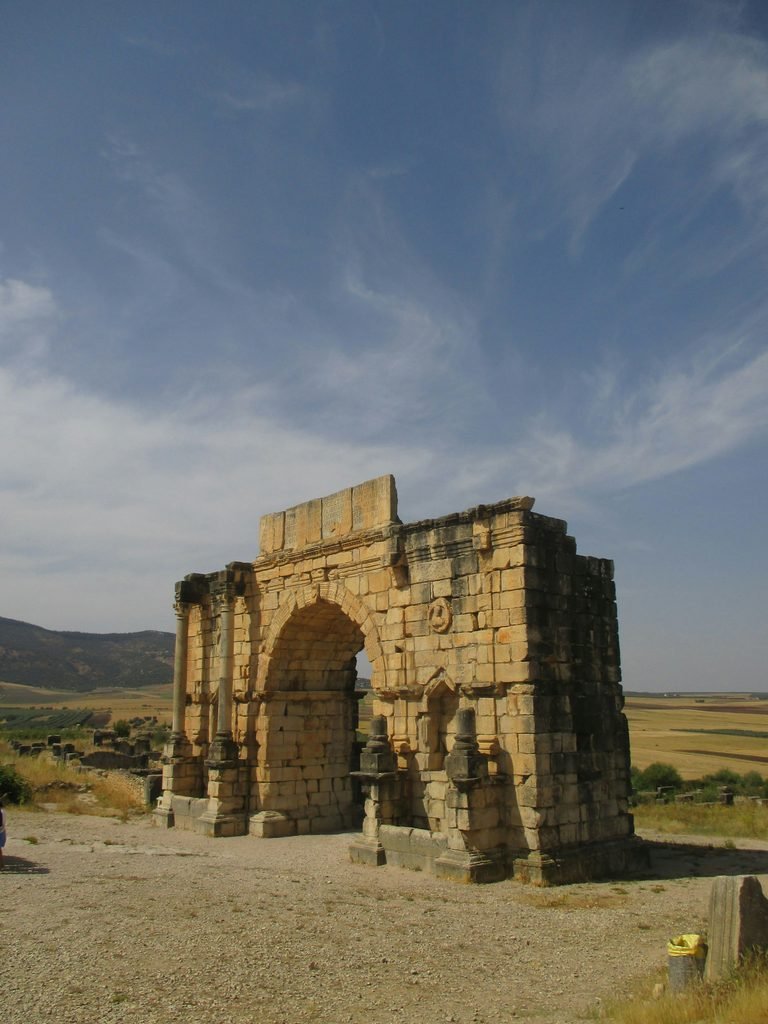
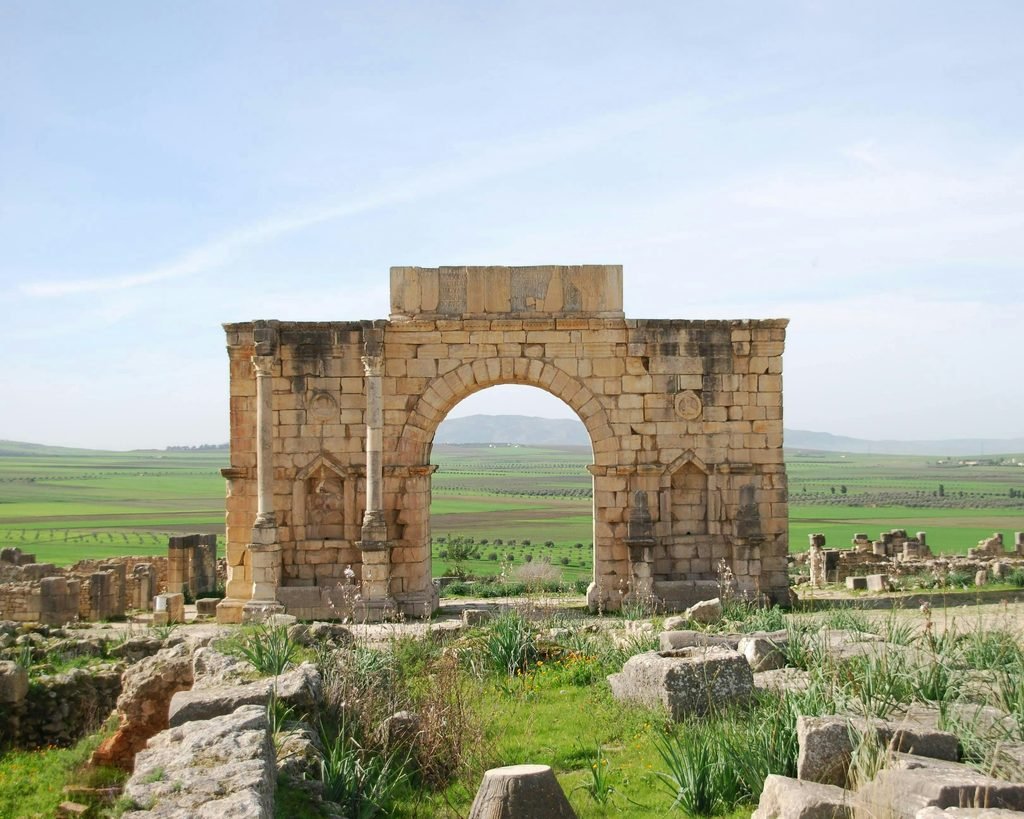
One of the most recognizable monuments at Volubilis is the Arch of Caracalla.
The arch was constructed in the third century CE and honored the Roman Emperor Caracalla.
Its presence demonstrates how connected Volubilis was to the political world of the Roman Empire.
An imperial monument in a city on the northwestern edge of Africa sent a clear message:
Volubilis was part of the Roman world.
The Arch of Caracalla
| Feature | Historical Significance |
|---|---|
| Type | Roman triumphal monument |
| Period | Third century CE |
| Honored figure | Emperor Caracalla |
| Purpose | Celebrated imperial authority |
| Modern importance | One of Volubilis’s most recognizable landmarks |
For modern visitors, the arch creates one of the most memorable photographs at the site.
But it is also much more than a beautiful ruin.
It represents the relationship between a distant province and the imperial power centered thousands of kilometers away.
The Capitol and Roman Religion
Religion played an important role in Roman urban life.
Cities often included temples and ceremonial spaces connected with official religious practices.
At Volubilis, the Capitol was one of the city’s major religious structures.
Roman religious traditions were closely connected to political life.
Honoring gods, participating in public ceremonies and demonstrating loyalty to the imperial system could all form part of civic identity.
Religion in Roman Volubilis
| Religious Element | Role |
|---|---|
| Temples | Places of worship and public ceremony |
| Capitol | Major religious complex |
| Roman gods | Part of official religious traditions |
| Imperial cult | Connected religion and political authority |
| Local traditions | Continued to influence religious life |
Like many parts of the Roman world, Volubilis was shaped by cultural interaction rather than a single completely uniform identity.
The Famous Mosaics of Volubilis
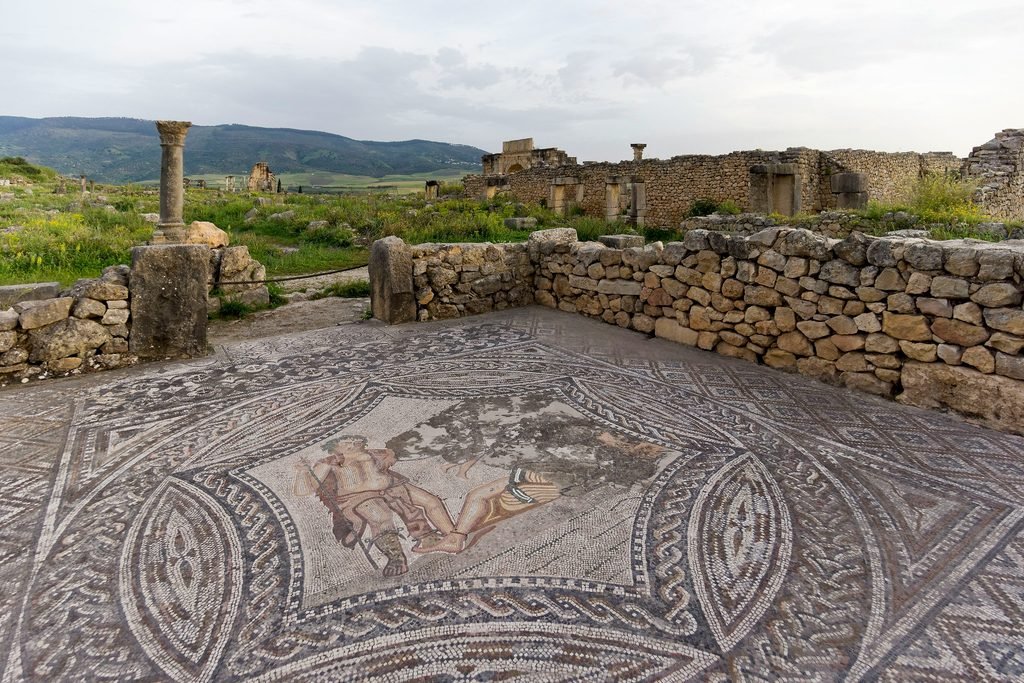
Perhaps the greatest artistic treasures of Volubilis are its mosaics.
Many remain in their original locations, giving visitors a rare opportunity to see ancient art within the spaces where it was created.
The mosaics decorated the floors of wealthy residences and often represented scenes from mythology and daily life.
Figures from Roman mythology, animals and elaborate decorative designs appear across the site.
Famous Themes in Volubilis Mosaics
| Theme | Examples |
|---|---|
| Roman mythology | Stories involving gods and legendary figures |
| Animals | Wild and domestic animals |
| Nature | Plants and decorative patterns |
| Hunting | Scenes reflecting elite activities |
| Entertainment | Images connected with ancient leisure |
| Symbolic designs | Geometric and decorative compositions |
The preservation of these mosaics is one reason Volubilis is considered exceptional.
Instead of seeing every artwork removed to a museum, visitors can encounter many of them in the architectural spaces where they originally formed part of daily life.
Why Were Mosaics Important?
Mosaics were not simply decoration.
For wealthy homeowners, they could communicate status, education and cultural connections.
A visitor entering a large residence might immediately understand the wealth and social position of its owner.
The subjects chosen for mosaics could also reflect the owner’s familiarity with mythology and elite Roman culture.
What a Mosaic Could Communicate
| Feature | Possible Meaning |
|---|---|
| Size | Wealth and investment |
| Complexity | Access to skilled craftsmanship |
| Mythological scenes | Cultural knowledge and status |
| Rare materials | Economic resources |
| Placement in the home | Importance of entertaining guests |
| Artistic style | Connection with wider Roman traditions |
These artworks therefore help historians understand both art and society.
Agriculture and the Economy of Roman Morocco
Volubilis was located within a fertile agricultural region.
Agriculture formed one of the foundations of its economy.
The surrounding countryside could support grain, olives and other crops, while the city was connected to wider trade networks.
Olive production was particularly important.
Archaeological remains associated with processing and production demonstrate the economic importance of agricultural resources.
Economy of Roman Volubilis
| Economic Activity | Importance |
|---|---|
| Agriculture | Supported the population and regional economy |
| Olive cultivation | Major source of production |
| Olive oil | Important for food, trade and daily life |
| Grain | Supported local and wider markets |
| Craft production | Provided goods for local use and exchange |
| Trade | Connected Volubilis with regional and Mediterranean networks |
The city’s wealth did not come only from its connection to Rome.
It also depended on the productive landscape surrounding it.
Was Volubilis an Important Roman City?
Yes.
Volubilis became one of the major urban centers of Mauretania Tingitana.
Its monumental architecture, public buildings and wealthy residences demonstrate its significance.
However, it should not be compared directly with Rome itself or with the largest cities of the empire.
Volubilis was important because of its role within Roman Morocco and the western edge of North Africa.
Why Volubilis Was Important
| Reason | Explanation |
|---|---|
| Political role | Major city within Mauretania Tingitana |
| Economic strength | Supported by productive agricultural land |
| Urban development | Included major Roman-style public buildings |
| Strategic location | Connected inland territories with northern networks |
| Cultural significance | Demonstrates interaction between Roman and North African societies |
| Archaeological preservation | Provides exceptional evidence of ancient life |
The Roman Frontier in Morocco
Roman authority did not cover the entirety of modern Morocco.
The empire concentrated its administration and military presence in strategically important northern regions.
Beyond these areas, direct control became weaker.
This is another reason Roman Morocco should not be imagined as a complete Roman occupation of the entire modern country.
Roman Presence in Modern Morocco
| Region | Level of Roman Connection |
|---|---|
| Northern coastal areas | Stronger Roman influence |
| Tingis/Tangier region | Major Roman importance |
| Volubilis region | Important Roman urban center |
| Some inland areas | Connected to Roman administration and frontier systems |
| High Atlas | Largely outside direct Roman urban administration |
| Deep Sahara | Outside direct Roman control |
This frontier nature gives Roman Morocco its own distinctive history.
It was both part of the empire and a meeting point between imperial power and societies beyond direct Roman rule.
The Decline of Direct Roman Control
Over time, Roman control over the region weakened.
By the later Roman period, the empire faced political, military and economic challenges across its vast territories.
Direct Roman administration did not disappear from Volubilis overnight.
Instead, the relationship between the city and the imperial system gradually changed.
Local populations continued to inhabit the region after the decline of direct Roman authority.
The Changing World of Volubilis
| Period | Development |
|---|---|
| High Roman era | Strong urban development and imperial connection |
| Later Roman period | Changing political and economic conditions |
| Decline of direct control | Roman administration became increasingly limited |
| Post-Roman period | Local communities continued to inhabit the area |
| Early Christian era | New religious and cultural developments |
| Early Islamic era | The region entered another major historical chapter |
The end of Roman rule was therefore not the end of Volubilis.
Volubilis After the Romans
One of the most fascinating things about Volubilis is that its history continued after Rome.
The site remained connected with the region through later historical periods.
Christian communities left evidence of their presence.
Later, the region became connected with the rise of Islam and the early history of the Moroccan state.
This long sequence is one reason UNESCO describes Volubilis as a site representing Mauritanian, Roman, Christian and Islamic civilizations.
Historical Layers of Volubilis
| Historical Period | Connection to the Site |
|---|---|
| Pre-Roman | Indigenous and Mauritanian settlement |
| Roman | Major urban development |
| Christian | Evidence of changing religious communities |
| Early Islamic | Connected with the Idrisid era |
| Medieval | Regional population and historical memory continued |
| Modern | Major archaeological and tourist destination |
Volubilis is therefore not frozen in one century.
Its ruins tell a story of continuity and transformation.
Volubilis and the Arrival of Islam
The region around Volubilis became important again during the early Islamic history of Morocco.
Nearby Moulay Idriss Zerhoun is closely associated with Idris I, one of the most important figures in the formation of the first major Islamic state in Morocco.
The Idrisid dynasty emerged during the late eighth century and played a crucial role in Morocco’s political and religious development.
The connection between Volubilis and this early Islamic period creates a remarkable historical sequence.
Within a relatively small geographical area, travelers can explore evidence of:
- Indigenous North African history
- Ancient Mauretania
- Roman Morocco
- Early Christianity
- The beginnings of Islamic Morocco
Few regions in Morocco offer such a concentrated historical journey.
The Earthquake That Damaged Volubilis
Volubilis experienced significant damage over the centuries.
The ruins seen today are the result of abandonment, natural processes, human activity and historical events.
The major Lisbon earthquake of 1755 is traditionally associated with additional damage to the site and surrounding region.
However, Volubilis had already undergone centuries of transformation before this event.
The image of one sudden event completely destroying a living Roman city would therefore be inaccurate.
Its decline and transformation took place over a long period.
Why Volubilis Became a Ruin
| Factor | Effect |
|---|---|
| Decline of Roman authority | Reduced connection with imperial structures |
| Changing trade patterns | Affected urban economic life |
| Population changes | Altered the character of settlement |
| Natural weathering | Damaged exposed structures |
| Earthquakes | Contributed to structural destruction |
| Reuse of building materials | Changed and reduced surviving architecture |
| Passage of time | Gradually transformed the ancient city into ruins |
How Was Volubilis Rediscovered?
Volubilis was never completely erased from the landscape.
Its ruins remained known locally, but systematic archaeological investigation and restoration brought international attention to the site.
Excavations revealed streets, buildings, inscriptions and mosaics that transformed understanding of Roman Morocco.
Today, the archaeological site provides one of the clearest physical records of ancient life in the country.
Archaeology at Volubilis
| Discovery Type | Historical Value |
|---|---|
| Buildings | Reveal urban planning and architecture |
| Mosaics | Provide evidence of art and elite life |
| Inscriptions | Help identify political and social history |
| Tools and objects | Offer clues about daily life |
| Industrial remains | Demonstrate economic activity |
| Burial evidence | Helps researchers understand ancient communities |
Archaeology continues to shape how historians understand Volubilis.
The story is based not only on ancient written sources but also on what survives beneath and above the ground.
Why Is Volubilis a UNESCO World Heritage Site?
Volubilis was inscribed on the UNESCO World Heritage List because of its exceptional archaeological value and the way it reflects multiple periods of Moroccan history.
UNESCO emphasizes the site’s importance as a substantial archaeological complex preserving evidence of different civilizations and cultural traditions.
UNESCO Importance of Volubilis
| UNESCO Value | Why It Matters |
|---|---|
| Archaeological preservation | Major parts of the ancient city remain visible |
| Roman heritage | One of North Africa’s important Roman sites |
| Mauritanian history | Preserves evidence from pre-Roman political history |
| Cultural layers | Includes Roman, Christian and Islamic connections |
| Urban remains | Streets and public buildings reveal ancient city life |
| Mosaics | Exceptional artistic heritage |
| Moroccan history | Connects ancient and later chapters of the country |
What Can You See at Volubilis Today?
Visitors can walk through a large archaeological landscape containing some of Morocco’s best-preserved ancient remains.
The experience is different from visiting a museum.
You are outside, moving through the remains of streets and buildings while looking across the surrounding countryside.
Highlights of a Visit to Volubilis
| Attraction | What You Will See |
|---|---|
| Arch of Caracalla | One of the site’s most famous Roman monuments |
| Decumanus Maximus | Main ancient street |
| Capitol | Major Roman religious structure |
| Basilica | Civic and administrative architecture |
| Forum | Center of public life |
| Ancient houses | Remains of private residences |
| Floor mosaics | Detailed ancient artworks |
| Olive production remains | Evidence of the city’s agricultural economy |
| Panoramic landscape | Views across the surrounding Moroccan countryside |
The site is especially rewarding for travelers who take their time.
A rushed visit may show you impressive ruins.
A slower visit reveals how the city actually functioned.
How to Visit Volubilis
Volubilis is often visited from Meknes or Fez, although it can also form part of a longer Morocco itinerary.
A private driver or organized tour can be useful for travelers combining Volubilis with Moulay Idriss and Meknes.
Volubilis Travel Planning Table
| Starting Point | Best Visit Style |
|---|---|
| Meknes | Half-day or full-day historical excursion |
| Fez | Day trip with Moulay Idriss |
| Rabat | Part of a longer northern Morocco route |
| Chefchaouen | Multi-day itinerary stop |
| Casablanca | Longer cultural journey through northern Morocco |
| Marrakech | Multi-day private tour through Morocco |
For travelers passionate about history, Volubilis works particularly well as part of an itinerary connecting Fez, Meknes, Moulay Idriss and northern Morocco.
Best Time to Visit Volubilis
Because Volubilis is an outdoor archaeological site, the time of year and time of day can significantly affect your experience.
Spring and autumn generally offer more comfortable conditions for walking around the ruins.
Morning visits can also provide a more pleasant experience, particularly during warmer months.
Seasonal Guide to Visiting Volubilis
| Season | Travel Experience |
|---|---|
| Spring | Comfortable temperatures and green surrounding landscapes |
| Summer | Hot conditions, especially during midday |
| Autumn | Pleasant weather for outdoor exploration |
| Winter | Cooler temperatures and occasional rain |
For photography, early or later daylight can create more dramatic views across the ruins.
How Much Time Do You Need at Volubilis?
The answer depends on your interest in history.
A quick visit may last around one to two hours.
However, history lovers can easily spend longer walking through the city, studying mosaics and understanding the relationship between different structures.
Suggested Visit Duration
| Type of Traveler | Recommended Time |
|---|---|
| Quick visitor | Around 1 hour |
| General tourist | 1.5–2 hours |
| History enthusiast | 2–3 hours |
| Archaeology enthusiast | 3+ hours |
A knowledgeable guide can significantly improve the experience because many of the ruins require historical context to fully understand.
Volubilis, Moulay Idriss and Meknes: Morocco’s Perfect History Route
One of the best ways to experience Volubilis is by combining it with nearby historical destinations.
This creates an extraordinary journey through different periods of Moroccan history.
One Region, Three Major Historical Experiences
| Destination | Historical Period |
|---|---|
| Volubilis | Mauritanian, Roman and later history |
| Moulay Idriss Zerhoun | Early Islamic Morocco and Idrisid heritage |
| Meknes | Imperial Morocco and Alaouite history |
In a single day or extended route, travelers can move from ancient Rome to early Islamic Morocco and then into one of Morocco’s great imperial cities.
This is history experienced geographically.
Volubilis vs Other Roman Sites in North Africa
Volubilis is not the only Roman archaeological site in North Africa.
Important Roman sites also exist in countries such as Tunisia, Algeria and Libya.
However, Volubilis is particularly significant because of its position at the western edge of the Roman world and its combination of Roman, indigenous and later Moroccan historical layers.
What Makes Volubilis Different?
| Feature | Volubilis |
|---|---|
| Location | Northwestern edge of Roman Africa |
| Pre-Roman history | Strong Mauritanian and indigenous context |
| Famous remains | Mosaics, arch, streets and public buildings |
| Later history | Christian and early Islamic connections |
| Landscape | Located within the Moroccan countryside |
| Travel experience | Easily combined with imperial and Islamic historical sites |
Its value lies not only in how Roman it was, but in how many different histories meet there.
Frequently Asked Questions About Roman Morocco and Volubilis
Was Morocco part of the Roman Empire?
Parts of northern Morocco were incorporated into the Roman Empire. The region was organized into the province of Mauretania Tingitana, while large parts of modern Morocco remained outside direct Roman administration.
Was Volubilis built by the Romans?
No. Volubilis existed before Roman rule. It developed as part of the ancient Mauritanian world and was later expanded under Roman administration.
Why is Volubilis important?
Volubilis is important because it preserves evidence of several periods of Moroccan history, including indigenous North African, Mauritanian, Roman, Christian and early Islamic connections.
How old are the ruins of Volubilis?
The site has roots extending back to the pre-Roman period, while many of the monumental structures visible today date from the Roman era.
Is Volubilis worth visiting?
Yes. For travelers interested in history, archaeology or ancient civilizations, Volubilis is one of the most important historical sites in Morocco.
Can you visit Volubilis from Fez?
Yes. Volubilis is commonly visited as a day trip or excursion from Fez, often combined with Moulay Idriss Zerhoun and Meknes.
What was Mauretania Tingitana?
Mauretania Tingitana was a Roman province covering parts of northern Morocco. Its name came from Tingis, the ancient city of Tangier.
What happened to Volubilis after the Romans left?
The region continued to be inhabited and the site remained connected with later Christian and Islamic historical developments. Over centuries, changing political and economic conditions gradually transformed the ancient city.
What is the most famous monument in Volubilis?
The Arch of Caracalla is among the most recognizable monuments, while the site’s mosaics are also major highlights.
Final Thoughts: Rome at the Edge of Morocco
Volubilis changes the way many travelers see Morocco.
It reveals a chapter of history that often receives less attention than the country’s famous Islamic dynasties and imperial cities.
Yet Roman Morocco was real.
Roman streets once carried merchants and officials. Wealthy homes displayed elaborate mosaics. Farmers cultivated the fertile countryside. Public buildings reflected imperial authority.
At the same time, Volubilis remained fundamentally connected to North Africa.
It existed before Rome.
It survived after Rome.
Its people and surrounding communities were part of a much longer history than the Roman Empire itself.
That is why Volubilis is so remarkable.
It is not just the story of Rome in Morocco. It is the story of Morocco before, during and after Rome.
From the indigenous populations of ancient Mauretania to the Roman province of Mauretania Tingitana, and from the early Islamic world to modern Morocco, Volubilis stands as one of the country’s most powerful reminders that Moroccan history has always been connected to civilizations far beyond its borders.
Explore Morocco’s Ancient History with Morocco Global Travel
A visit to Volubilis can become much more than a stop between cities when it is placed within the wider story of Morocco.
Morocco Global Travel can help you build a journey connecting ancient Volubilis with the imperial cities of Meknes and Fez, the early Islamic heritage of Moulay Idriss and the many other historical landscapes that shaped the country.