Alaouite Dynasty History
Morocco’s history is a story of dynasties rising from different regions, building powerful cities, defending the country’s independence and leaving behind monuments that still define the Moroccan landscape. Among all of them, the Alaouite Dynasty is unique because it is the ruling dynasty of Morocco today.
The Alaouites emerged during the 17th century, after the decline of the Saadian Dynasty. Their rise brought a new period of political consolidation, territorial organization and diplomatic engagement with European powers and the wider Islamic world.
The dynasty’s effective establishment of central authority is traditionally associated with 1666 CE, when Sultan Moulay Ismail consolidated Alaouite power in Morocco. His reign would become one of the most consequential in the country’s history.
From the imperial cities of Meknes, Fez and Marrakech to the fortified landscapes of eastern and southern Morocco, the Alaouite period left a powerful architectural and political legacy.
Most importantly, the dynasty survived the dramatic transformations of the 19th and 20th centuries and remains Morocco’s ruling house today.
Who Are the Alaouites?
The Alaouites, also known as the Alawite or Alaouite dynasty, are a Sharifian dynasty that claims descent from the Prophet Muhammad through his grandson Hassan ibn Ali.
Their origins are traditionally connected with Tafilalt, an oasis region in southeastern Morocco that has historically been an important center of Saharan commerce.
Their rise came at a time when Morocco was experiencing political fragmentation.
After the decline of the Saadians, central authority weakened and different local powers controlled various parts of the country. The Alaouites gradually expanded their influence from southeastern Morocco before establishing themselves as the dominant political force.
| Alaouite Milestone | Date |
|---|---|
| Alaouite family rises in Tafilalt | 17th century |
| Moulay Sharif becomes an important regional leader | 1631 |
| Moulay Ismail becomes Sultan | 1672 |
| Alaouite power consolidated | 1660s–1670s |
| Meknes developed as imperial capital | Late 17th–early 18th century |
| Moulay Ismail dies | 1727 |
| French Protectorate begins | 1912 |
| Morocco regains independence | 1956 |
| Modern Alaouite monarchy continues | Present |
The exact dates used for the dynasty’s beginning can vary depending on whether historians refer to its emergence in Tafilalt, the establishment of its rule over major Moroccan territories or the consolidation of central authority.
From Tafilalt to the Moroccan Throne
The story of the Alaouites begins far from the royal palaces of today’s Rabat.
Tafilalt, located on the edge of the Sahara, was historically connected to trans-Saharan trade routes. Caravans crossed this region carrying goods between Morocco and communities farther south.
This environment shaped the political and commercial world from which the Alaouites emerged.
The dynasty’s religious lineage helped provide legitimacy, while its leaders gradually built alliances and military strength.
The decline of Saadian authority created an opportunity for the Alaouites to expand beyond their southeastern base.
Over time, they brought increasingly large parts of Morocco under their authority.
Moulay Ismail: The Sultan Who Rebuilt Morocco
When discussing Alaouite history, one ruler stands out above almost all others: Sultan Moulay Ismail.
He ruled for more than five decades and became one of Morocco’s most powerful monarchs.
Moulay Ismail inherited a fragmented political landscape. His challenge was not simply to become Sultan, but to establish effective authority across a country divided among rival tribal, religious and regional powers.
His solution combined military organization, diplomacy, strategic alliances and monumental construction.
The result was a major transformation of Morocco.
Why Did Moulay Ismail Choose Meknes?
One of Moulay Ismail’s most important decisions was to make Meknes his principal imperial capital.
Rather than relying entirely on the established royal centers of Fez and Marrakech, he transformed Meknes on an enormous scale.
Meknes became a vast royal complex containing palaces, granaries, stables, gardens, mosques, monumental gates and defensive walls.
The city’s architecture reflected Moulay Ismail’s vision of a centralized and powerful monarchy.
The historic city of Meknes remains one of the most important places to understand Alaouite history.
Bab Mansour: The Famous Gateway of Meknes
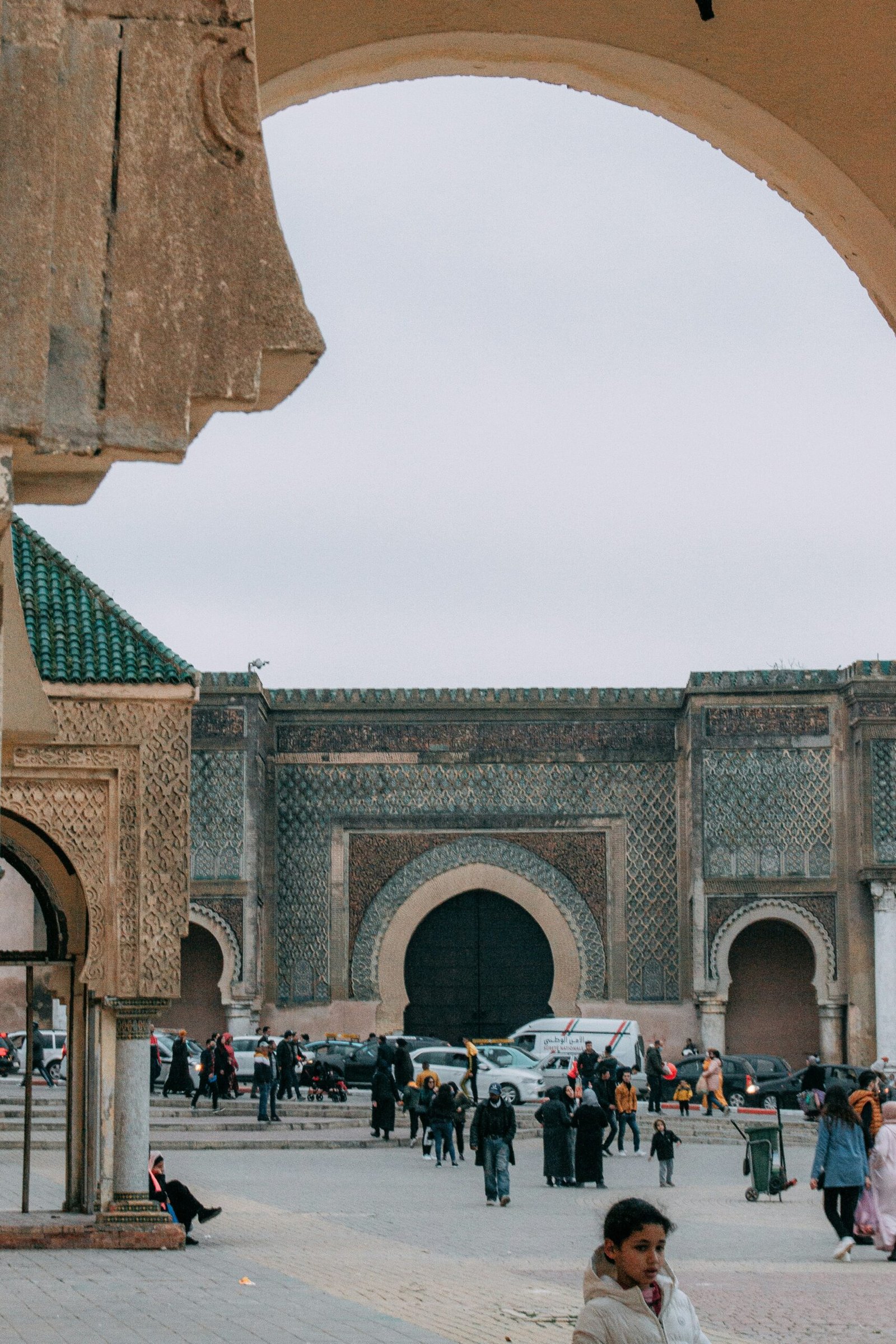
Among Meknes’s most recognizable monuments is Bab Mansour.
The monumental gate demonstrates the architectural ambitions of the Alaouite period through its enormous proportions and elaborate decorative details.
Zellij tilework, carved elements and monumental arches combine to create one of Morocco’s most recognizable historic gateways.
For travelers, Bab Mansour is more than a beautiful photo opportunity.
It represents the scale of Moulay Ismail’s architectural program and the importance he placed on Meknes as an imperial capital.
The Royal Granaries and the Vision of Moulay Ismail
Moulay Ismail’s architectural projects were not limited to palaces.
He constructed enormous storage facilities and stables designed to support the royal court and military.
The Heri es-Souani, often associated with royal granaries and stables, is one of the most fascinating surviving structures from his reign.
Its enormous spaces demonstrate the logistical demands of maintaining a powerful centralized state.
This is an important reminder that imperial architecture was not always designed simply for beauty.
Some buildings existed to solve practical problems: storing grain, housing animals, accommodating soldiers and supporting the administration of a large kingdom.
Moulay Ismail and the Black Guard
One of Moulay Ismail’s most significant military innovations was the development of a highly organized army known as the Black Guard, or Abid al-Bukhari.
The force was intended to provide the Sultan with a military organization directly loyal to the central government.
This strengthened his ability to project authority throughout Morocco.
The creation and organization of this army became one of the defining features of Moulay Ismail’s long reign.
It helped him confront rebellions, strengthen control over strategic regions and maintain the authority of the monarchy.
Morocco and European Powers
The Alaouite period also coincided with increasing European involvement in North Africa.
European maritime powers had established coastal positions in Morocco during earlier centuries, while trade and diplomacy increasingly connected Morocco with European states.
The Alaouites had to balance military defense, commercial interests and international diplomacy.
Morocco’s geographical position made this especially important.
The country stood between the Atlantic and Mediterranean worlds while also maintaining historic connections with sub-Saharan Africa.
This gave Moroccan rulers considerable strategic importance but also exposed the country to increasing European pressure.
Morocco’s Strategic Atlantic Coast
The Alaouite era saw continued attention to Morocco’s Atlantic ports.
Cities such as Essaouira, Rabat, Salé and El Jadida became important parts of Morocco’s maritime history.
Essaouira in particular developed as an important port under the Alaouite Sultan Sidi Mohammed ben Abdallah in the 18th century.
The city’s strategic location allowed Morocco to strengthen its Atlantic commercial connections.
Its distinctive fortifications, harbor and medina still reflect this period.
Sidi Mohammed ben Abdallah and a New Era of Diplomacy
Another important Alaouite ruler was Sidi Mohammed ben Abdallah, who ruled during the 18th century.
His reign is remembered for commercial and diplomatic initiatives.
He recognized the growing importance of international trade and strengthened Morocco’s connections with foreign merchants and states.
Under his rule, Essaouira was developed into an important commercial port.
This period illustrates how Morocco was adapting to a changing world.
European maritime powers were becoming increasingly influential, global commerce was expanding and diplomatic relationships were becoming more important than ever.
Morocco and the United States
One particularly interesting chapter of Alaouite history involves Morocco’s relationship with the newly independent United States.
Morocco was among the first countries to recognize the United States as an independent nation.
The Treaty of Marrakesh, signed in 1787, formalized diplomatic and commercial relations between the two countries.
This relationship remains an important part of Moroccan diplomatic history.
For American travelers visiting Morocco today, it is an interesting reminder that relations between Morocco and the United States extend back more than two centuries.
The Alaouites and the Modernization of Morocco
During the 19th century, Morocco faced increasingly difficult circumstances.
European powers were expanding their influence across North Africa, while industrialization and military modernization were changing the balance of power.
Moroccan rulers attempted various reforms to modernize the military, administration and economy.
But maintaining independence became increasingly difficult.
The country’s strategic location made Morocco particularly attractive to European powers seeking influence in North Africa.
The 1912 Protectorate
A major turning point came in 1912, when Morocco became a French protectorate, while Spain established control over several northern and southern zones.
The Sultan remained in place, but real political authority was heavily constrained by the colonial administration.
This period fundamentally changed Morocco’s political, economic and urban landscape.
French colonial planners developed new administrative cities alongside historic medinas, creating the distinctive urban structure visible in cities such as Rabat, Casablanca and Fez.
Mohammed V and the Road to Independence
The Alaouite monarchy played a central role in Morocco’s independence movement.
Sultan Mohammed V became an important symbol of Moroccan national identity during the struggle against French colonial rule.
He was exiled in 1953, an event that generated significant resistance and strengthened popular support for the monarchy.
He returned to Morocco in 1955.
Morocco regained independence in 1956, and Mohammed V became the country’s first king of the modern independent era.
His legacy remains deeply embedded in Morocco’s modern national identity.
Hassan II and Modern Morocco
After Mohammed V’s death in 1961, his son Hassan II became king.
His reign lasted from 1961 to 1999 and was one of the most consequential periods in modern Moroccan history.
Hassan II pursued a strong centralized monarchy while also overseeing major infrastructure and national development projects.
One of the most famous monuments associated with his reign is the Hassan II Mosque in Casablanca.
The mosque’s location beside the Atlantic Ocean and its monumental scale make it one of Morocco’s most recognizable modern landmarks.
Its construction also demonstrates the continued relationship between Moroccan monarchy, architecture and national identity.
Morocco Under King Mohammed VI
Since 1999, Morocco has been ruled by King Mohammed VI.
His reign has included significant infrastructure development, tourism investment, urban transformation and social and economic reforms.
Morocco has also invested heavily in transport infrastructure, renewable energy, cultural preservation and tourism development.
For travelers, many of the modern experiences available today exist alongside centuries-old historic environments.
A journey through Morocco can therefore move from a contemporary city to a medieval medina and then into a centuries-old kasbah landscape within the same day.
The Alaouite Dynasty and Morocco’s Imperial Cities
The Alaouites inherited and developed Morocco’s historic imperial cities.
Each city tells a different part of the dynasty’s story.
| City | Alaouite Connection |
|---|---|
| Meknes | Transformed dramatically under Moulay Ismail |
| Fez | Continued as a major religious, scholarly and cultural center |
| Marrakech | Remained an important royal and cultural city |
| Rabat | Became the modern capital of Morocco |
| Casablanca | Developed into Morocco’s major economic and commercial center |
This makes Morocco especially rewarding for history-focused travelers.
Rather than visiting a single historic capital, you can experience several cities that represent different stages of the country’s political development.
Best Places to Discover Alaouite History
| Destination | What to Experience |
|---|---|
| Meknes | Bab Mansour, royal quarters, monumental walls and Moulay Ismail’s legacy |
| Rabat | Royal history, Hassan Tower and modern Moroccan political heritage |
| Fez | Historic medina, royal architecture and centuries of scholarship |
| Marrakech | Palaces, medina and the transition between earlier and later dynasties |
| Essaouira | Alaouite-era port, ramparts and Atlantic history |
| Tafilalt | Origins of the Alaouite family and Saharan heritage |
| Casablanca | Modern Morocco and the Hassan II Mosque |
Alaouite Architecture Through the Centuries
One of the most fascinating aspects of the Alaouite legacy is that it spans several centuries.
Unlike earlier dynasties whose architectural legacy is concentrated in particular historical periods, Alaouite Morocco continued developing over generations.
The result is an architectural story that moves from monumental imperial gates to modern mosques and contemporary urban landmarks.
| Period | Architectural Character |
|---|---|
| 17th–18th centuries | Imperial palaces, monumental gates and fortified complexes |
| 18th century | Port cities and Atlantic fortifications |
| 19th century | Royal architecture combined with increasing foreign influence |
| 20th century | Colonial-era urban planning alongside traditional medinas |
| Modern period | Contemporary Moroccan architecture inspired by traditional design |
Why the Alaouite Dynasty Matters Today
The importance of the Alaouite Dynasty goes beyond its longevity.
It is the dynasty that connects Morocco’s pre-modern political history with the modern Moroccan state.
Its story includes the rise of Moulay Ismail, the transformation of Meknes, the development of Atlantic ports, Morocco’s diplomatic relationships, the colonial period, independence and the country’s modern monarchy.
Few historical dynasties provide such a direct bridge between the past and the present.
When travelers visit Morocco today, they are not simply exploring the remains of a vanished royal family.
They are visiting a country whose current monarchy belongs to the same dynastic tradition.
Alaouite Dynasty Timeline
| Date | Event |
|---|---|
| 17th century | Alaouite family rises in Tafilalt |
| 1631 | Moulay Sharif becomes a significant regional leader |
| 1660s | Alaouite authority expands across Morocco |
| 1672 | Moulay Ismail becomes Sultan |
| Late 17th century | Meknes undergoes major imperial development |
| 1727 | Death of Moulay Ismail |
| 18th century | Morocco strengthens international commercial and diplomatic relations |
| 1787 | Treaty of Marrakesh establishes formal relations with the United States |
| 1912 | French Protectorate established |
| 1956 | Morocco regains independence |
| 1961 | Hassan II becomes King |
| 1999 | Mohammed VI becomes King |
| Today | Alaouite dynasty continues to rule Morocco |
Frequently Asked Questions About the Alaouite Dynasty
When did the Alaouite Dynasty begin?
The Alaouites emerged as a major political force during the 17th century, rising from Tafilalt in southeastern Morocco. Their authority expanded significantly during the 1660s and 1670s.
Who was the most important Alaouite ruler?
Moulay Ismail is one of the dynasty’s most important historical rulers. His long reign was characterized by political consolidation, military organization and the transformation of Meknes into an imperial capital.
Why is Meknes important to Alaouite history?
Moulay Ismail transformed Meknes into a major royal city, constructing enormous walls, gates, palaces, granaries and other royal facilities.
Are the Alaouites still ruling Morocco?
Yes. The Alaouite Dynasty remains Morocco’s ruling dynasty, with King Mohammed VI as the current monarch.
Where did the Alaouites originate?
The dynasty’s origins are traditionally associated with Tafilalt, a historic oasis region in southeastern Morocco.
What happened to Morocco in 1912?
Morocco became a French protectorate in 1912, while Spain established control over several northern and southern areas. The Moroccan Sultan remained on the throne, but the country’s sovereignty was severely restricted.
When did Morocco regain independence?
Morocco regained independence in 1956, during the reign of Mohammed V.
Discover the Morocco of the Alaouites
The Alaouite story is not confined to history books.
You can see it in the monumental gates of Meknes, the royal quarters of Rabat, the Atlantic walls of Essaouira and the modern landmarks of Casablanca.
You can travel through Tafilalt and discover the landscapes from which the dynasty emerged, then continue north toward the imperial cities that became centers of Moroccan political and cultural life.
This is what makes a historical journey through Morocco so rewarding: the country’s past is still visible in the places you visit.
At Morocco Global Travel, we can design journeys that connect Morocco’s dynastic history with the country’s landscapes, architecture, culture and hospitality. From imperial cities and ancient medinas to the Sahara Desert and the Atlantic coast, your itinerary can be shaped around the Morocco you genuinely want to discover.